
An ISO 9001 internal audit checklist is only useful if it makes auditors ask the questions an external auditor will ask. Most checklists fail because they copy clause titles into a table and tick boxes. This guide gives you ten questions that test whether your quality system actually works, with the evidence to look for behind each one.
It is written for quality managers and internal auditors who need a practical ISO 9001 internal audit checklist before a surveillance or recertification audit, including teams moving to the 2026 edition.
What an ISO 9001 Internal Audit Checklist Must Cover
Clause 9.2 requires you to run internal audits at planned intervals to check that the quality management system meets your own requirements and the standard. You need an audit programme, defined criteria and scope for each audit, auditors who are objective and impartial, results reported to relevant management, and retained evidence. ISO’s own overview names internal audits and management reviews as key to keeping a quality system effective.
ISO 9001:2026 was published in September 2026 and keeps the familiar clause structure, so a well-built ISO 9001 internal audit checklist carries over with a few updates. ISO 19011 gives general guidance on auditing management systems if you want a reference for audit technique.
How often should you use it? Most organisations split the programme into short audits across the year, covering two or three questions of the ISO 9001 internal audit checklist at a time. Smaller audits are easier to staff, leave time to fix findings, and avoid the pre-audit rush that hides real problems.
A good checklist works in two layers. The first layer asks whether the system is designed to meet the requirement. The second asks for proof that people follow it on the shop floor. Each question below covers both.
The 10-Question ISO 9001 Internal Audit Checklist
1. Is the audit programme planned around risk and past results?
Look for a programme that covers every process within the cycle, with frequency set by importance and earlier findings. A fixed calendar that audits every area equally, regardless of results, is a weak design. Ask to see how last year’s findings changed this year’s plan.
2. Does every audit have a stated scope, criteria and objective?
The audit plan should say which process, site and period is covered, and against what: the standard, your procedures and customer or legal requirements. Plans that say only “audit production” leave auditors guessing.
3. Are the auditors competent and independent of the work?
Auditors must not audit their own work. In a small company, borrow a trained auditor from another department or use an external one. Keep training and competence records for each auditor on file.
4. Do quality objectives have measurable targets and owners?
Clause 6.2 expects objectives that are measurable, monitored and tied to the quality policy. Check that targets exist, results are tracked against them, and someone is named as owner. Objectives such as “improve quality” fail this test.
5. Is documented information controlled in practice?
When you apply the ISO 9001 internal audit checklist on site, pick three documents at random on the shop floor and confirm they are the current approved version. Our document control guide explains what control should look like. Obsolete copies at workstations are among the most common findings.

6. Can people show they are competent for their roles?
Clause 7.2 asks for evidence of competence. Sample files for people in safety-critical or quality-critical roles, such as inspectors, welders or machine operators, and check qualifications, training and any re-assessment dates.
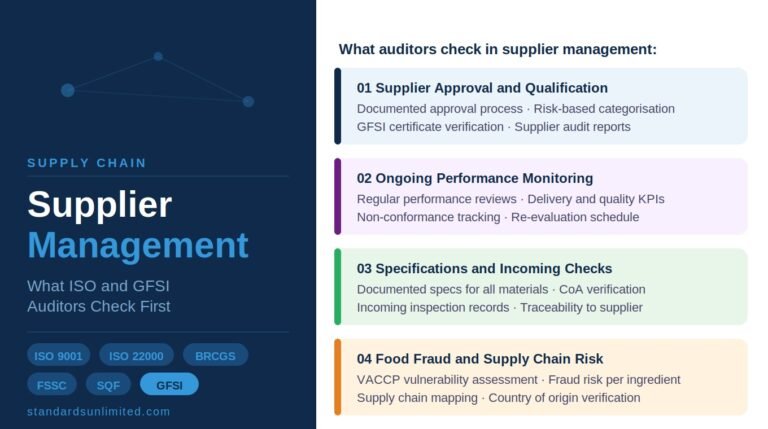
7. Are external providers evaluated and monitored?
Check the approved supplier list, the criteria used to select suppliers, and records of performance reviews. Our ISO 9001 supplier quality checklist covers this in detail.
8. Are nonconforming outputs identified and controlled?
Walk to the quarantine area. Is rejected product labelled, segregated and recorded? Trace one rejected batch from the record to the physical stock and confirm the disposition was authorised.
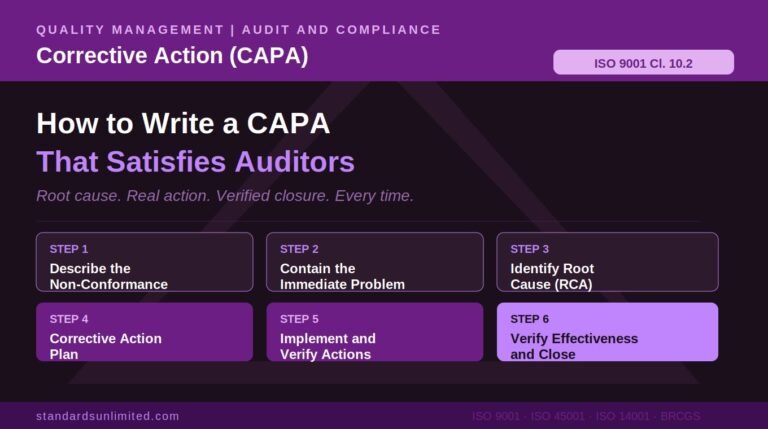
9. Do corrective actions address root cause and prove effectiveness?
Clause 10.2 requires you to react to nonconformities, evaluate the need to eliminate the cause and review the effectiveness of action taken. Closing an action by retraining the operator is rarely a root cause. Our corrective action guide shows how to prove an action worked.
10. Do audit results reach top management and feed the review?
Clause 9.2 requires results to be reported to relevant management, and they are an input to the management review. Check the minutes: if audit results are missing from the agenda, the loop is open.
Treat this ISO 9001 internal audit checklist as a base. Add questions for your own high-risk processes, such as calibration, sterilisation or heat treatment, and drop questions for areas that are out of scope.
Practical tip: turn each question into a sampling instruction, not a yes/no box. For example, “select five supplier files and check each has an evaluation dated within the last year”. Sampling forces auditors to look at evidence rather than ask for assurances.
Need these documents for ISO 9001:2026?
The ISO 9001:2026 Documentation Package includes an internal audit programme and clause-by-clause checklist, plus a quality manual, policy, 16 procedures and 3 Excel registers — already updated for the 2026 changes. Certified to 2015? The Transition Package covers just what changed.
Compare the ISO 9001:2026 packages →Related: ISO 9001 documentation required · ISO 9001 management review: 7 agenda items
GCC Example: A Dubai Packaging Manufacturer
This is an illustrative scenario based on patterns we see often. A packaging manufacturer in Dubai with about 120 employees runs its annual internal audit in the week before its surveillance visit. The quality manager audits every department himself, using a checklist copied from the standard’s clause titles.
The surveillance auditor then finds the same gaps the internal audit missed: obsolete work instructions on the printing line, no supplier evaluations for two imported film suppliers, and audit results that never reached the last management review. The fix is not a longer checklist. The company splits the audit across the year, trains a second auditor from the warehouse team so nobody audits their own area, and rewrites its ISO 9001 internal audit checklist as sampling questions like the ones above.
Common Mistakes with an ISO 9001 Internal Audit Checklist
- Copying clause titles. A checklist that restates the standard tells auditors nothing about what to sample.
- One audit before the external visit. Cramming everything into one week gives no time to fix what you find.
- Auditing your own work. It breaks the impartiality requirement and hides real findings.
- Yes/no ticks without evidence. If the record does not name the document or batch checked, it proves nothing.
- Findings with no follow-up. Nonconformities need owners and dates, or the same finding returns next year.
- Ignoring the 2026 edition. Update wording and references in your ISO 9001 internal audit checklist when you update the rest of your system.
For a wider look at why internal audits miss problems, read why internal audits still fail external audits.
Consultant Tip: Audit the Trail, Not the Document
Pick one customer order and follow it from contract review through purchasing, production, inspection and delivery. One trail touches most clauses at once and shows where records break between departments. Run it first, then use your ISO 9001 internal audit checklist to cover the process areas the trail did not reach.
Get your QMS ready for ISO 9001:2026
- 28 editable Word and Excel documents for the sixth edition
- Risks and opportunities, change planning and quality culture covered
- Internal audit checklist and management review pack
- Already certified? Transition Package from
Written by a practising lead auditor · Editable Word & Excel · Instant download · ≈ AED 547
Conclusion: Make Your ISO 9001 Internal Audit Checklist Work
A strong ISO 9001 internal audit checklist asks for evidence, uses sampling, and feeds findings straight into corrective action and management review. Plan the programme across the year, keep auditors independent, and review the checklist itself after every cycle. Our audit ready checklist lists the documents to have on hand, and the combined audit template helps if you also run ISO 14001 or ISO 45001.
If you would rather adapt than draft from scratch, the ISO 9001:2026 Documentation Package provides editable Word and Excel templates for the quality manual, procedures and records your auditors will sample. Tailor them to your processes, and keep the evidence real.