An AI governance policy template can take you from a blank page to a signed policy in a few days, provided the policy it produces matches how your organisation really uses AI. The free Word template below is written to meet the AI policy requirement in ISO 42001, and you can edit it for your own organisation.
Most organisations already use AI, whether anyone decided they should. A support agent pastes a customer email into a chatbot. A developer accepts code from an assistant. HR screens CVs with a scoring plug-in that procurement bought last year. Without a policy, every one of those choices is made by an individual, with no owner, no limits and no record. ISO/IEC 42001:2023, the first international standard for AI management systems, expects top management to close that gap by setting an AI policy. Responsible AI practices (fairness, transparency, accountability and human oversight) give that policy its content.
This guide explains what an AI governance policy is, what ISO 42001 asks for, what to put in it, and how to customise the AI governance policy template without ending up with a document nobody follows.
What Is an AI Governance Policy?
An AI governance policy is a short document, approved by top management, that states how the organisation directs, controls and takes responsibility for its AI systems. It sets principles, assigns roles and commits the organisation to manage risk, meet legal requirements and keep improving.
It is not a technical specification and not a list of banned tools. It is the starting point for the rest of the AI management system (AIMS): procedures, risk assessments and records all trace back to it. You may see it called a responsible AI policy, an AI compliance policy or, in downloadable form, an artificial intelligence policy template. The name matters less than whether it meets clause 5.2 of the standard and whether staff follow it. It is also the first item of your AI management system documentation.
Why an AI Governance Policy Is Important
- Accountability. Each AI system gets a named owner, so problems do not fall between IT, legal and the business.
- Control of everyday AI use. Staff learn which tools are approved and what data must never go into them.
- Legal exposure. AI that handles personal data falls under data protection law, including the UAE federal personal data protection law and Saudi Arabia’s PDPL. Exporters to Europe also face the EU AI Act.
- Customer confidence. Customers who send supplier questionnaires expect to see a documented policy, and so does an acquirer running ISO 42001 due diligence checks.
- Certification. An auditor will ask for the AI policy at the start. Without one, there is no ISO 42001 certificate.
ISO 42001 Requirements Related to AI Governance
ISO/IEC 42001:2023 was published in December 2023 and is certifiable. It follows the same high-level structure as ISO 9001 and ISO 27001, so the clause numbering will look familiar if you have read our guide to the Annex SL process approach. The points that bear on governance are these:
- Clause 5.2, AI policy. Top management establishes a policy that suits the organisation’s purpose, provides a framework for setting AI objectives, commits to meeting applicable requirements and commits to continual improvement. It must be documented, communicated and available to interested parties as appropriate.
- Clauses 5.1 and 5.3. Leadership commitment, and defined roles, responsibilities and authorities.
- Clauses 6.1.2 to 6.1.4 and 6.2. AI risk assessment, risk treatment, AI system impact assessment and AI objectives.
- Annex A, groups A.2 and A.3. Controls for the AI policy (A.2.2), its alignment with other policies (A.2.3), its review (A.2.4), AI roles and responsibilities (A.3.2) and reporting of concerns (A.3.3).
Annex A holds 38 controls in nine groups. Any AI governance policy template you adopt should be checked against these points. Wording above is paraphrased, so check it against your licensed copy of the standard from the ISO standards catalogue. Many policies also borrow from the free OECD AI Principles and the NIST AI Risk Management Framework.
What Should Be Included in an AI Governance Policy Template?
Nine elements make a policy complete, and any AI governance policy template you use should cover all of them. Keep each to a few sentences.
- Purpose. Why the policy exists and which objectives it supports.
- Scope. Every AI system the organisation develops, buys or uses, including generative AI and AI built into software you license. A Riyadh software company, for example, should name its coding assistants as well as its own models.
- AI principles. Six to eight statements such as accountability, fairness, transparency, privacy, safety and human oversight, each with a practical meaning.
- Roles and responsibilities. Top management, an AI governance lead, system owners, data owners, IT, procurement and all staff, with authority to stop a system that is causing harm.
- Risk management. A commitment to assess risk and impact before deployment and after material change, with a rule for who accepts high residual risk.
- Data governance. Lawful basis, minimisation, data quality, provenance and retention, plus a ban on entering confidential or personal data into unapproved tools.
- Monitoring and review. Performance monitoring, incident reporting, internal audit, management review and a review of the policy itself at least annually.
- Compliance requirements. The laws, regulations and contracts that apply, and the consequence of breaching the policy.
- Continuous improvement. How audit findings, incidents and suggestions feed back into the system.
Free AI Governance Policy Template Download
The free AI governance policy template is a four-page Word document you can edit and use for your own organisation or client projects. Use it as your ISO 42001 policy template. It contains:
- A document control header with the ISO 42001 clause and Annex A references
- Fifteen numbered sections covering purpose, scope, policy statement, principles, roles, risk and impact assessment, data governance, third-party and generative AI, transparency, monitoring, compliance, improvement, communication, related documents and approval
- Tables for principles and for roles and responsibilities
- [BRACKETED] fields wherever your own details are needed
- A one-page customisation checklist and a table showing where the template meets clause 5.2 and controls A.2.3, A.2.4 and A.3.2
Download the free AI governance policy template (Word, 4 pages)
It is a policy, not an AIMS. It does not include the procedures, risk tools, registers or audit records an auditor will ask to see, and it is not legal advice.
How to Customize the AI Governance Policy Template
Follow these eight steps to turn the AI governance policy template into your own policy.
- List your AI systems first. Use an inventory, not memory. Include AI features inside tools you buy.
- Write the scope from that list. A Dubai fintech running a customer chatbot and an HR screening tool would name both.
- Adapt the principles. Keep them short enough for staff to remember.
- Assign real roles. Name the AI governance lead and make sure top management will back the stop authority.
- Check every commitment against practice. Remove any review, timescale or control you do not actually run.
- Add your legal requirements. Keep a legal compliance register behind the compliance section.
- Get top management to read and sign it. Their approval is what makes it the AI policy under clause 5.2.
- Communicate it and keep proof. Brief staff, record who was briefed, and file the signed version under document control.
Common Mistakes Organizations Make
- Copying an AI governance policy template word for word. Auditors spot generic text that does not match the organisation.
- Writing for the auditor, not for staff. A policy nobody reads cannot control anything.
- Naming no owner. “The company is responsible” means nobody is.
- Leaving out embedded and third-party AI. Most day-to-day AI use arrives inside software you buy.
- Promising controls you do not run. “Every model is bias-tested quarterly” becomes a nonconformity if it is not true.
- Having no link to risk assessment. The policy says risks will be managed, yet no method exists. Our ISO 27001 risk assessment template shows the kind of method to adopt.
- Ignoring generative AI. Staff pasting client data into public chatbots is the most common real incident.
- Treating an AI governance policy template as the finished system. Without procedures and records, there is no evidence the policy is applied.
- Skipping review. A policy last updated before your newest AI system is out of date.
- Not communicating it. A signed policy that staff have never seen does not satisfy the standard.
Benefits of ISO 42001 Compliance
- A faster start: a well-built AI governance policy template removes weeks of drafting
- Clear accountability for every AI system
- Fewer AI incidents, and faster containment when one occurs
- Evidence for customers, tenders and investors that AI is under control
- A structure that supports legal compliance, though ISO 42001 certification is not legal compliance in itself
- A certifiable system that sits alongside ISO 27001 and ISO 9001 without duplicating effort
Frequently Asked Questions
Is the AI governance policy template really free?
Yes. Download it, edit it and use it for your own organisation or client projects. Reselling or redistributing the file is not permitted.
Does an AI governance policy template alone meet ISO 42001?
No. Clause 5.2 requires a policy, but the standard also requires risk and impact assessment, objectives, operational controls, monitoring, internal audit and management review.
Who should approve the policy?
Top management. The standard makes the AI policy their responsibility, so delegating the signature weakens it.
How long should an AI governance policy be?
Three to five pages is typical. Put detail in procedures and keep the policy readable.
What is the difference between an AI governance policy and an AI acceptable use policy?
The governance policy sets direction for the whole organisation. An acceptable use policy tells staff what they may and may not do with specific tools.
Do startups and small companies need an AI governance policy template?
Yes, in proportion to their size. A two-page policy with clear owners is better than none, especially if you sell to larger customers.
How often should the policy be reviewed?
At least annually, and after any major change in AI use, law or organisation. Control A.2.4 covers review at planned intervals.
Does ISO 42001 satisfy the EU AI Act?
No. ISO 42001 is a voluntary management system standard, and the EU AI Act is law with its own requirements and timetable. Its timetable was revised in 2026, so confirm current dates before planning.
Can consultants use the AI governance policy template for clients?
Yes, for client implementation projects. Reselling or sharing the original file is not allowed.
Do I also need a separate responsible AI policy?
Usually not. The principles section does that job. Some organisations also publish a short external statement for customers.
Need the Complete ISO 42001 Documentation Package?
The free AI governance policy template is one document. A working ISO 42001 management system needs far more than the policy:
- Policies
- Procedures
- Risk assessment tools
- Registers
- Internal audit materials
- Management review forms
- Records and templates
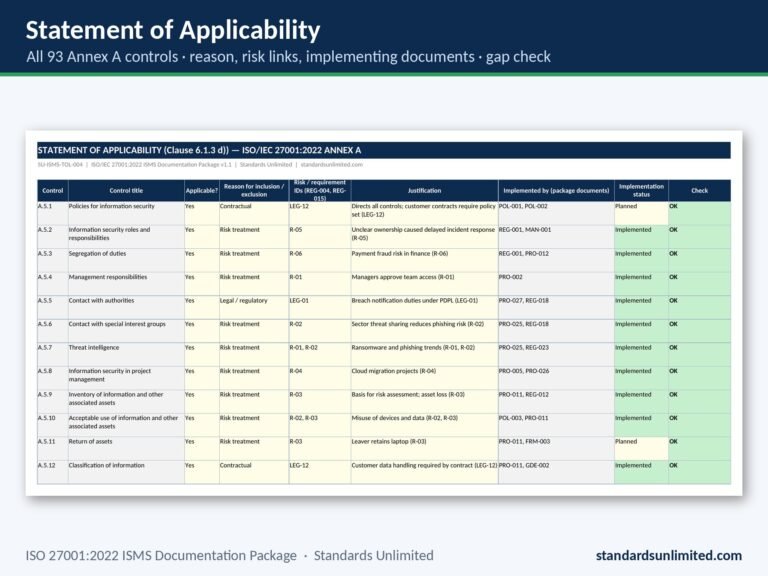
The Standards Unlimited ISO 42001 Documentation Package provides the other ISO 42001 documents as 101 editable Word and Excel files: an AIMS manual, seven policies, 26 procedures, nine SOPs and a Statement of Applicability covering all 38 Annex A controls. It also includes risk and impact assessment tools, a generative AI risk worksheet, supplier checklists, an internal audit programme with an Annex A checklist, and management review forms. If you want a lighter start, see the ISO 42001 AI Governance Toolkit.
Conclusion
A good AI governance policy template saves drafting time, but the value comes from what you do with it: list your systems, name owners, remove empty promises and get top management to sign. Download the free AI governance policy template, adapt it this week, and then build the procedures and records that show it works. When you are ready for the full system, the ISO 42001 Documentation Package gives you the rest.