Acquiring a company with AI at its core is not like buying a conventional software business. The value often sits in models, training data and the decisions those systems make, and so do the risks. ISO 42001 M&A due diligence gives buyers a structured, auditable way to test those risks before signing.
Why AI deals need a different kind of diligence
Traditional technology diligence looks at code, contracts and cybersecurity. With an AI target, buyers must also ask where training data came from, who owns the models, how outputs are monitored, and whether the business can explain and defend its automated decisions. Legal advisers increasingly recommend AI-specific diligence protocols covering technical architecture, data provenance, intellectual property and regulatory compliance.
Regulation adds pressure. Rules such as the EU AI Act apply in phases and carry real penalties, and a buyer that inherits a non-compliant system inherits the exposure with it. Data protection obligations matter too, as our GDPR compliance guide explains.
The difficulty is that much of this is invisible in a financial data room. A target may say it governs its AI responsibly, but a policy deck is not evidence. Buyers need proof that governance operates in practice, which is where ISO 42001 M&A due diligence adds value.
Why ISO 42001 M&A due diligence works for acquirers
ISO/IEC 42001:2023 is the first international standard for an AI management system. It sets requirements for how an organisation establishes, implements, maintains and improves the way it develops or uses AI, including risk assessment, impact assessment, defined roles, monitoring and continual improvement. Its Annex A lists controls covering areas such as data quality, transparency, third-party relationships and the AI system life cycle.
For a buyer, that creates a common yardstick for ISO 42001 M&A due diligence. A target with a certified, or at least well-implemented, management system can show a documented scope, risk treatment and internal audit results. A target without one is not necessarily a bad deal, but you should price in the cost and time of building one.
Seven checks to build into your ISO 42001 M&A due diligence plan
- Scope and inventory. Ask for a register of every AI system the target builds, buys or embeds, and confirm which are inside the management system’s scope.
- Certification status. If the target claims ISO 42001 certification, request the certificate, the certification body, the scope statement and the latest audit report, including any open nonconformities.
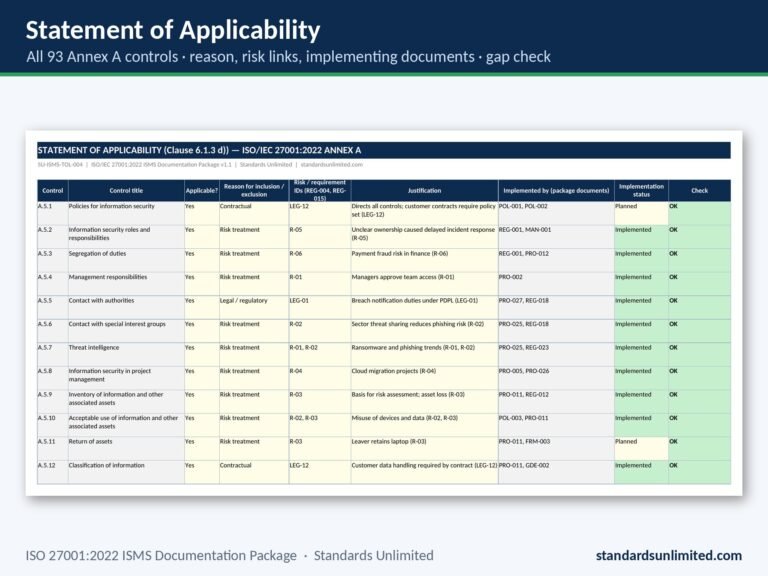
- Statement of Applicability. Review which Annex A controls were included or excluded and whether the justifications are credible.
- Data provenance. Verify licences, consents and sources for training and testing data, and look for restrictions that may not survive a change of control.
- AI risk and impact assessments. Check that assessments exist for high-impact systems, were updated after changes, and led to real treatment actions.
- Third-party dependencies. Map reliance on foundation models, APIs and data vendors, including contract terms on liability, data use and continuity.
- Incident and monitoring records. Request logs of model failures, bias complaints and security events, and how each was resolved.
In every ISO 42001 M&A due diligence review, ask for records rather than statements. Meeting minutes, audit reports and change logs tell you far more than a policy document does.
ISO 42001 M&A due diligence red flags that should change the deal terms
Some findings should trigger renegotiation rather than a note in the file. Watch for a certificate whose scope excludes the product you are buying, an internal audit programme that has never run, training data with unclear rights, and key models maintained by one or two individuals with no documented process.
Valuation gaps can often be bridged through specific representations and warranties, indemnities, escrow arrangements or earn-outs tied to remediation milestones. The stronger your evidence, the more precisely you can draft them.
Integration after closing
ISO 42001 M&A due diligence does not end at signing. Within the first months, decide whether the target’s management system will be merged into yours or run alongside it, and update the scope accordingly. Certification bodies expect changes in ownership, structure and AI use to be reflected in the management system, so plan an early internal audit of the combined operation. Aligning AI governance with existing programmes such as ISO 27001 or ISO 9001 also reduces duplicated effort.
Final thoughts
AI will keep driving deal activity, and buyers who treat AI governance as a core diligence workstream are better placed to value targets accurately and avoid inherited liabilities. Using ISO 42001 as the framework turns a vague conversation about responsible AI into specific documents, records and audit evidence you can test.
If your team needs compliance documentation to prepare for ISO 42001 M&A due diligence on an AI-related transaction, the ISO 42001 AI Governance Toolkit from Standards Unlimited includes a gap assessment, risk register and implementation templates.