
GDPR compliance 2026 presents new challenges for organisations operating in the EU and beyond. When GDPR came into force in May 2018, many organisations treated it as a one-time compliance project. They appointed a data protection officer, updated their privacy policies, added cookie banners to their websites, and considered the job done.
Eight years later, regulators are making clear that GDPR compliance is not a project. It is a permanent, evolving operational obligation. Cumulative GDPR fines have now exceeded €7.1 billion. Enforcement is accelerating, not slowing. And in 2026, the compliance landscape has shifted significantly — with AI data obligations, new Digital Omnibus proposals, and enforcement priorities that many organisations are simply not prepared for.
This guide covers everything you need to know about GDPR compliance 2026 — what has changed, what regulators are focusing on, and what your organisation needs to do right now.
More information about GDPR fines or enforcement: European Data Protection Board : https://www.edpb.europa.eu
WHAT IS GDPR AND WHO DOES IT APPLY TO?
The General Data Protection Regulation (GDPR) is the European Union’s flagship data privacy law. It governs how organisations collect, use, store, and transfer the personal data of EU and EEA residents.
Critically — GDPR applies regardless of where your organisation is based. If you process the personal data of EU residents — whether as customers, website visitors, newsletter subscribers, or employees — GDPR applies to you. An organisation based in the UAE, UK, US, or Australia with EU customers is subject to GDPR.
There is no size exemption. A three-person startup faces the same core GDPR requirements as a Fortune 500 company. The regulation provides some documentation relief for organisations with fewer than 250 employees — but the fundamental obligations apply to all.
GDPR COMPLIANCE 2026: ENFORCEMENT LANDSCAPE
The enforcement climate in 2026 is unambiguous. Regulators have shifted from education to enforcement.
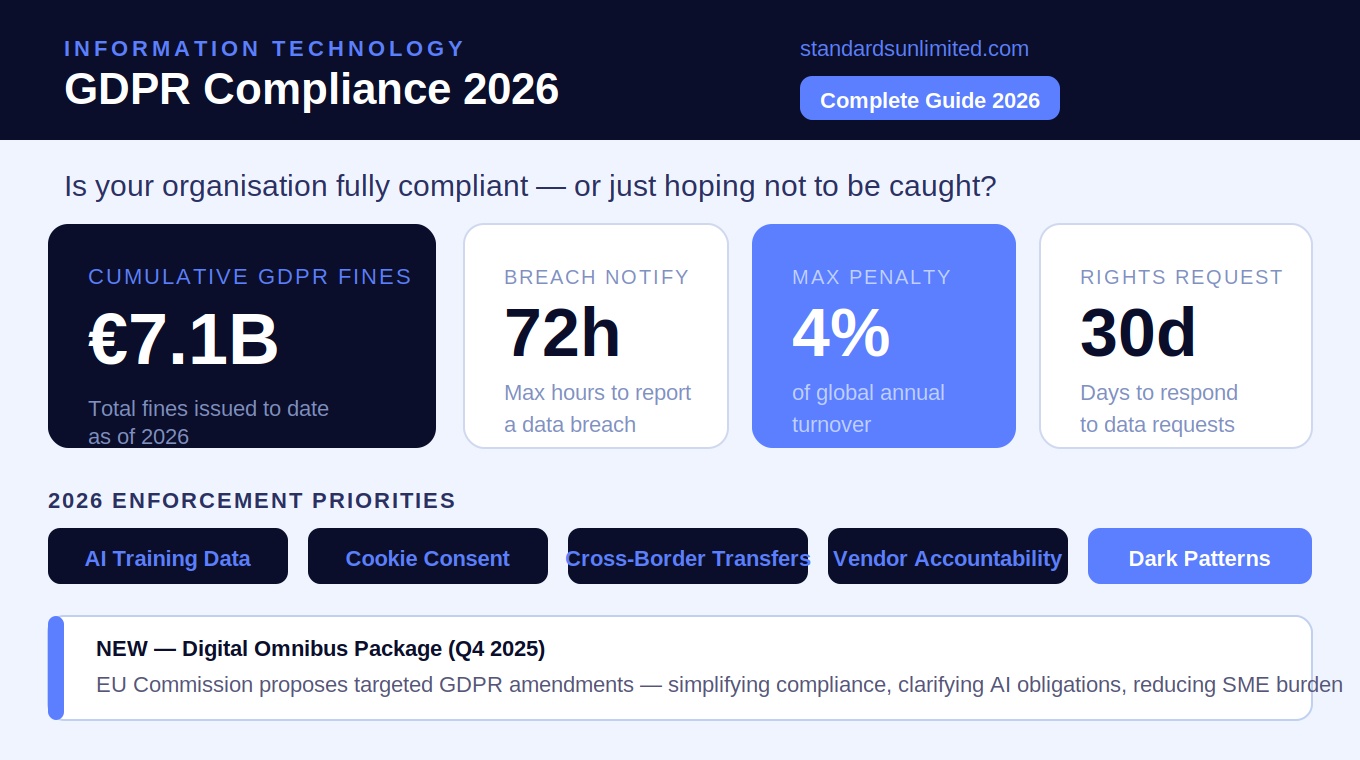
📊 Cumulative GDPR fines: over €7.1 billion since 2018
📊 Fines issued in 2024 alone: approximately €1.2 billion
📊 Maximum penalty: up to 4% of global annual turnover
📊 Breach notification deadline: 72 hours to notify the supervisory authority
📊 Rights request response: 30 days maximum
The five enforcement priorities for 2026:
- AI training data — organisations using personal data to train AI models must demonstrate lawful basis and data minimisation
- Cookie consent — dark patterns, pre-ticked boxes, and consent that is not freely given remain high priority
- Cross-border data transfers — Standard Contractual Clauses, adequacy decisions, and transfer impact assessments
- Vendor accountability — all data processors must be covered by compliant Data Processing Agreements
- Dark patterns — user interface designs that manipulate users into providing more data than intended
THE DIGITAL OMNIBUS PACKAGE — NEW IN LATE 2025
In late 2025, the European Commission introduced the Digital Omnibus Package — a set of proposed targeted amendments to GDPR aimed at simplifying compliance without altering individuals’ core data rights.
Key proposed changes include:
✅ Simplified cookie consent requirements for certain low-risk processing
✅ Expanded documentation exemptions for SMEs with fewer than 500 employees
✅ Clearer legal bases for AI processing, research, and statistical purposes
✅ Simplified breach notification for low-risk incidents
These are proposals — not yet law. Monitor their progression through the EU legislative process in 2026 and 2027.
THE 10 CORE GDPR REQUIREMENTS YOUR ORGANISATION MUST HAVE
Understanding these requirements is essential for achieving GDPR compliance 2026 and avoiding costly enforcement action.
- Lawful Basis for Every Processing Activity
Every processing activity must have a documented lawful basis — consent, legitimate interests, contract performance, legal obligation, vital interests, or public task. The legitimate interests basis faces increased scrutiny in 2026 — you must demonstrate necessity and balance against data subjects’ rights. - Privacy Notice (Privacy Policy)
A clear, accessible, plain-language privacy notice explaining what data you collect, why, how long you keep it, who you share it with, and individuals’ rights. Must be kept current as your processing activities change. - Record of Processing Activities (ROPA)
A documented register of all data processing activities — required for organisations with more than 250 employees, or any organisation whose processing is likely to result in risk. Maps what data you hold, where it comes from, who you share it with, and how long you keep it. - Data Processing Agreements (DPAs) with All Processors
Every third-party supplier processing personal data on your behalf must be covered by a Data Processing Agreement meeting GDPR Article 28 requirements. This includes cloud providers, HR systems, marketing platforms, IT support providers, and any supplier with access to personal data. - Data Subject Rights Procedures
Documented processes to respond to subject access requests, erasure requests, rectification requests, and data portability requests within 30 days. The right to erasure is a priority enforcement area in 2026 — organisations must have efficient, documented deletion processes. - Data Protection Impact Assessments (DPIAs)
Required before any processing likely to result in high risk — including large-scale processing of sensitive data, systematic monitoring, and AI systems using personal data. Biometric data processing triggers DPIA requirements automatically. - Breach Response Procedure
A documented procedure for identifying, assessing, and responding to personal data breaches — including notification to the supervisory authority within 72 hours where the breach is likely to result in risk to individuals. - Data Retention Policy
A documented policy specifying how long each category of personal data is retained — and procedures for secure deletion when retention periods expire. Data must not be kept longer than necessary for its purpose. - Data Protection Officer (DPO)
Required for public authorities, organisations engaging in large-scale systematic monitoring, and organisations processing special categories of data at large scale. Even where not legally required, designating a privacy lead is strongly recommended. - International Transfer Safeguards
If you transfer personal data outside the EU/EEA, appropriate safeguards must be in place — Standard Contractual Clauses, an adequacy decision, Binding Corporate Rules, or another approved mechanism. This includes transfers to cloud providers with servers outside the EU.
GDPR AND AI — THE 2026 CHALLENGE
2026 marks the convergence of GDPR and the EU AI Act. Organisations using AI systems that process personal data face overlapping obligations from both frameworks. For many organisations, AI governance has become one of the most challenging aspects of GDPR compliance 2026
Key intersections:
→ AI training data — controllers deploying AI must verify lawful data acquisition for training datasets
→ Automated decision-making — Article 22 GDPR restrictions on fully automated decisions overlap with AI Act high-risk system requirements
→ Human oversight — both GDPR and the EU AI Act require human oversight for high-risk AI systems
→ Model transparency — individuals have the right to meaningful information about automated decision-making logic
The August 2026 enforcement date for EU AI Act high-risk system requirements is approaching. Organisations that have not built data governance infrastructure to support both frameworks are running out of time.
THE GDPR COMPLIANCE 2026 SELF-CHECK — DO THIS TODAY
Run through this checklist right now:
✅ Do you have a documented lawful basis for every processing activity?
✅ Is your privacy notice current and accessible?
✅ Do you have a ROPA covering all processing activities?
✅ Do you have Data Processing Agreements with every data processor?
✅ Do you have a documented procedure for responding to data subject requests within 30 days?
✅ Have you conducted DPIAs for high-risk processing activities?
✅ Do you have a documented breach response procedure with the 72-hour notification timeline?
✅ Do you have a data retention policy with scheduled deletion processes?
✅ Are international data transfers covered by Standard Contractual Clauses or other approved mechanisms?
✅ Have you reviewed your AI processing activities for both GDPR and EU AI Act compliance?
If you cannot answer yes to all ten — you have compliance gaps that regulators are actively pursuing in 2026.
THE BOTTOM LINE
GDPR compliance 2026 is not a one-off project.. It is a continuous operational obligation that evolves as your business changes, as technology changes, and as regulatory enforcement priorities evolve.
The enforcement climate is clear: regulators are no longer warning organisations. They are fining them. With cumulative penalties exceeding €7.1 billion and 2026 enforcement priorities specifically targeting AI data, cookie consent, and vendor accountability, the cost of non-compliance has never been higher.
Build your compliance programme around the ten core requirements. Keep it current. Test it regularly. The organisations that treat data privacy as a genuine governance priority — not a compliance checkbox — are the ones that navigate 2026 without finding themselves in a regulatory spotlight.