
ISO 50001 — Your Organisation Is Wasting Energy and Money. Here Is How to Stop.
Energy is the single largest controllable cost for most manufacturing, logistics, and facilities operations. Yet in 2026, the majority of organisations still manage energy the way they managed it in the 1990s — reactively, anecdotally, and without systematic data.
ISO 50001 changes that. It is the international standard for Energy Management Systems — a structured, proven framework that helps organisations identify where energy is being wasted, set measurable objectives to reduce it, and demonstrate continual improvement over time.
In 2026, ISO 50001 has moved from a nice-to-have to a strategic necessity — driven by rising energy costs, tightening EU regulation, and the growing demand from investors and customers for verified sustainability performance.
WHAT IS ISO 50001?
ISO 50001 is the internationally recognised standard for Energy Management Systems (EnMS). It provides a framework for organisations to:
✅ Identify and manage Significant Energy Uses (SEUs) across their operations
✅ Establish Energy Performance Indicators (EnPIs) to measure consumption systematically
✅ Set Energy Baselines (EnBs) to measure improvement against
✅ Define and track energy objectives and targets
✅ Implement action plans to improve energy performance
✅ Demonstrate continual, measurable improvement over time
Like ISO 9001 and ISO 14001, ISO 50001 uses the Plan-Do-Check-Act (PDCA) cycle and the Harmonised Structure — making it straightforward to integrate with your existing management systems.
It applies to any organisation, in any sector, of any size. It does not specify a target energy performance level — it requires organisations to identify their own significant energy uses and set targets appropriate to their operations.
WHY ISO 50001 MATTERS MORE IN 2026 THAN EVER BEFORE
- The EU Energy Efficiency Directive Is Now Mandatory for Many Organisations
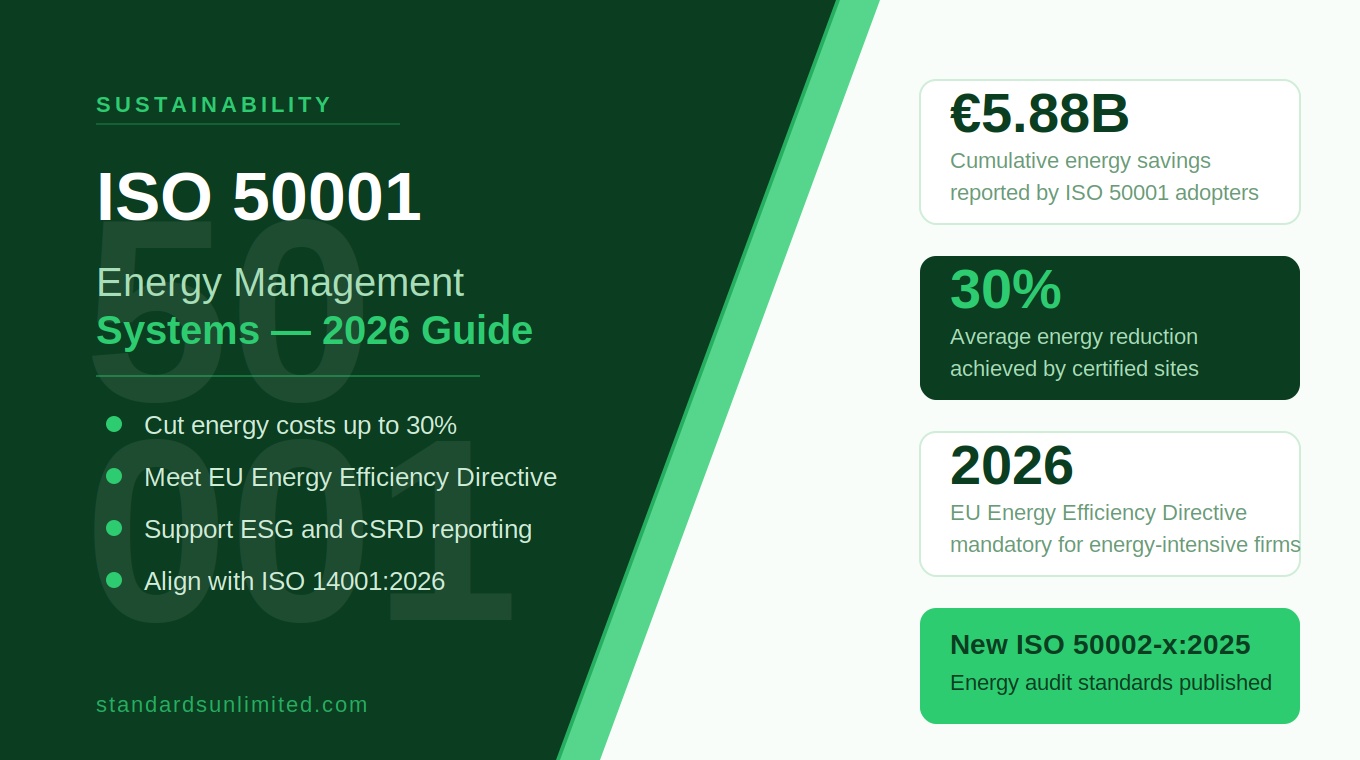
Since 2025, EU Member States have been required to introduce regulations obliging energy-intensive companies above defined consumption thresholds to implement energy management systems. ISO 50001 is the recognised standard for satisfying these requirements.
If your organisation operates in the EU and has significant energy consumption — manufacturing, data centres, logistics hubs, large commercial buildings — you may already be legally required to have an energy management system in place.
- Energy Costs Have Never Been More Volatile
The energy price shocks of recent years have fundamentally changed how boards view energy management. Organisations with systematic ISO 50001 systems — identifying waste, setting reduction targets, and tracking performance — are demonstrably more resilient to energy price volatility than those without.
- ISO 50001 Directly Supports ESG and CSRD Reporting
The EU Corporate Sustainability Reporting Directive (CSRD) requires large organisations to report on energy consumption, energy intensity, and progress toward efficiency targets. ISO 50001 provides the management system infrastructure that generates the verified, systematic data that CSRD and ESG frameworks require.
- New ISO 50002-x:2025 Energy Audit Standards Published
In 2025, a new series of energy audit standards was published alongside ISO 50001:
→ ISO 50002-1:2025 — General requirements for energy audits
→ ISO 50002-2:2025 — Energy audits for buildings
→ ISO 50002-3:2025 — Energy audits for processes
These new standards provide a structured, internationally recognised framework for conducting energy audits — a core activity within any ISO 50001 system.
- Certified Organisations Are Achieving Measurable Results
Organisations that implement ISO 50001 systematically are achieving energy cost reductions of 10 to 30 percent through structured identification and elimination of energy waste. These are verified improvements documented through the EnPI and EnB framework of the standard.
THE 7 CORE ELEMENTS OF AN ISO 50001 ENERGY MANAGEMENT SYSTEM
- Energy Review
A systematic analysis of your energy use and consumption. Identifies your Significant Energy Uses (SEUs) — the processes, equipment, and facilities consuming the most energy — and analyses historical energy data to establish your baseline. - Energy Performance Indicators (EnPIs)
Quantitative measures of energy performance specific to your organisation. Examples include energy consumed per unit produced, energy intensity per square metre of facility, or energy cost per tonne of output. - Energy Baseline (EnB)
A quantitative reference against which energy performance is compared. Your baseline is established from your energy review and is used to measure whether performance is genuinely improving — accounting for variables such as production volume, weather, or facility size. - Energy Objectives and Targets
Specific, measurable energy improvement goals linked to your significant energy uses. Examples: reduce compressed air energy consumption by 15% over 12 months; reduce facility heating energy intensity by 10% by year end. - Action Plans
Documented plans for achieving each energy objective — identifying who is responsible, what actions will be taken, what resources are needed, and how progress will be monitored. - Operational Controls
Procedures and controls for the operation and maintenance of processes and equipment identified as significant energy uses. Ensures energy performance is maintained and improved during day-to-day operations. - Monitoring, Measurement, and Analysis
Systematic monitoring of energy consumption, EnPI performance against baselines, and progress toward objectives. ISO 50001 requires calibrated monitoring equipment and accurate, reliable energy data.
ISO 50001 AND ISO 14001:2026 — HOW THEY WORK TOGETHER
ISO 14001:2026 and ISO 50001 are natural partners. ISO 14001:2026 now includes stronger requirements for addressing climate change and resource use — including energy — as part of an organisation’s environmental management system.
ISO 50001 goes deeper on energy: it provides the EnPI framework, energy baseline methodology, and systematic monitoring approach that complements ISO 14001’s environmental objectives. The new Harmonised Structure shared by both standards makes integration straightforward — reducing documentation duplication and enabling combined internal audits.
YOUR 12-STEP ISO 50001 IMPLEMENTATION GUIDE
- Secure top management commitment — energy management needs leadership resources and authority
- Appoint an Energy Management Team — identify who will lead and support the EnMS
- Conduct an Energy Review — audit energy use, identify significant energy uses, analyse historical data
- Establish your Energy Baselines (EnBs) — set your performance starting point
- Define Energy Performance Indicators (EnPIs) — determine how you will measure improvement
- Set Energy Objectives and Targets — specific, measurable goals linked to significant energy uses
- Develop Action Plans — documented improvement actions with owners, timelines, and resources
- Implement Operational Controls — procedures for significant energy uses
- Train and communicate — ensure relevant staff understand their role in energy performance
- Monitor, measure, and analyse — systematic data collection and performance review
- Conduct internal audit — verify the EnMS is working as intended
- Conduct management review — leadership assessment of EnMS performance and improvement
THE BOTTOM LINE
Energy management is no longer a facility management function. In 2026, it is a strategic business priority — driven by regulatory obligation, financial pressure, investor expectation, and the accelerating urgency of climate action.
ISO 50001 gives your organisation a proven, internationally recognised framework to manage energy systematically, reduce costs measurably, and demonstrate verified improvement to every stakeholder who asks.
The organisations that implement ISO 50001 now are cutting costs, meeting regulatory requirements, and building the verified sustainability performance data that investors, customers, and regulators are increasingly demanding.
Start with an energy review. Identify your significant energy uses. Set one measurable objective. That is all it takes to begin.