Is Your Organisation Cyber-Ready? The ISO 27001 Guide Every IT Manager Needs in 2026
Every week, another organisation makes headlines for the wrong reason. A data breach. A ransomware attack. Customer records leaked. Regulatory fines imposed. And in almost every case, the damage was preventable.
In 2026, cybersecurity is no longer a specialist concern reserved for IT departments. It is a boardroom priority, a regulatory requirement, and a customer expectation. And the world’s most widely used framework for managing information security risk is ISO 27001 — the international standard for Information Security Management Systems.
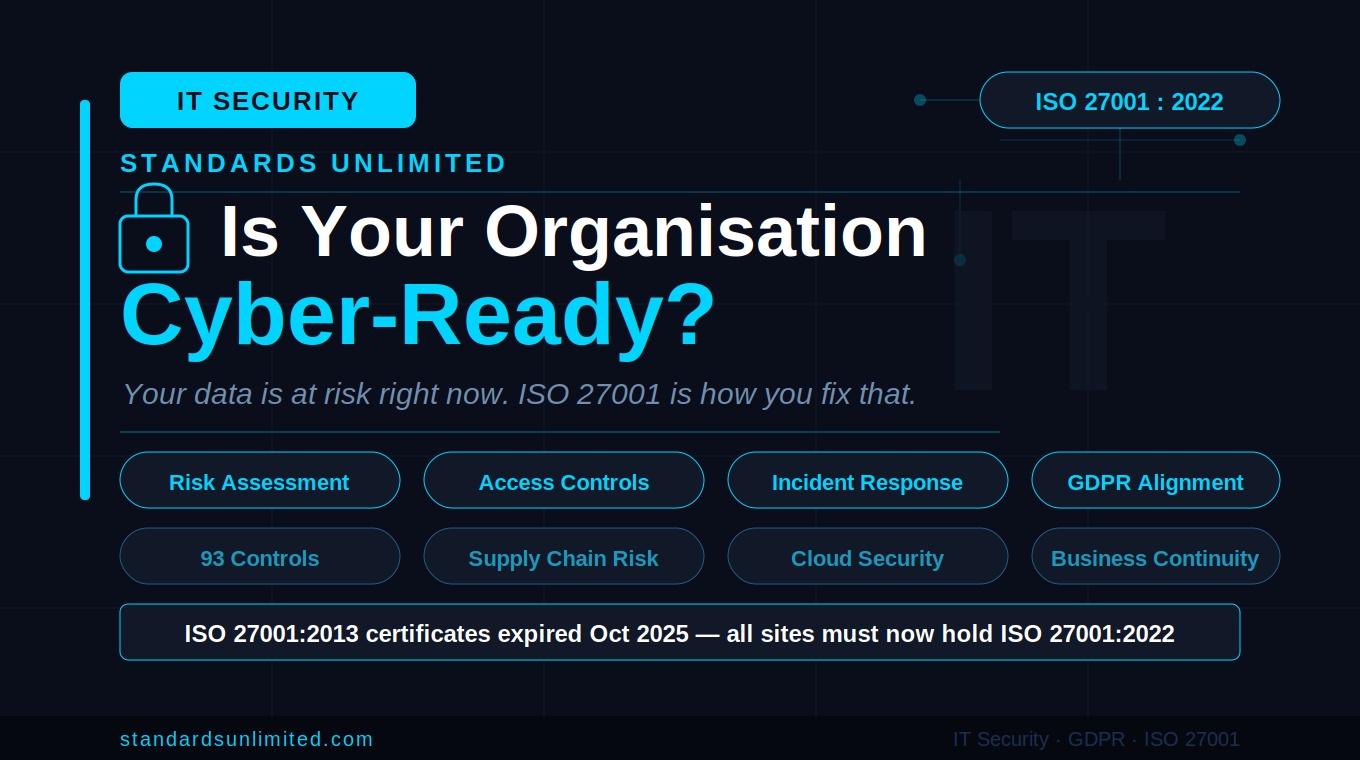
⚠️ Important: ISO 27001:2013 certificates expired on 31 October 2025. If your organisation still holds a 2013 certificate — it is no longer valid. All organisations must now hold ISO 27001:2022.
WHAT IS ISO 27001 AND WHY DOES IT MATTER?
ISO 27001 is the international standard for Information Security Management Systems (ISMS). It provides a framework for organisations to manage the security of assets such as financial information, intellectual property, employee data, and information entrusted by third parties.
Unlike prescriptive regulations that tell you exactly what controls to implement, ISO 27001 takes a risk-based approach. It requires your organisation to identify its information security risks, assess their likelihood and impact, and implement appropriate controls to manage them.
Why ISO 27001 matters more in 2026 than ever before:
✅ Cyber attacks continue to rise globally year on year
✅ GDPR and data protection regulations require demonstrable information security controls
✅ Supply chain attacks now account for over 40% of breaches — clients want proof you are secure
✅ ISO 27001 certification is increasingly required by enterprise customers as a condition of business
✅ Cyber insurance premiums are significantly lower for certified organisations
WHAT CHANGED IN ISO 27001:2022?
The 2022 revision introduced significant changes from the 2013 version:
📌 Controls reduced from 114 to 93 — consolidated and simplified into 4 themes
📌 11 brand new controls added covering modern threats
📌 5 new control attribute categories introduced
📌 Amendment 1:2024 adds mandatory climate change and environmental considerations
📌 Updated harmonised structure for easier integration with ISO 9001 and ISO 45001
THE 11 NEW CONTROLS YOU MUST IMPLEMENT:
- Threat intelligence
- Information security for use of cloud services
- ICT readiness for business continuity
- Physical security monitoring
- Configuration management
- Information deletion
- Data masking
- Data leakage prevention
- Monitoring activities
- Web filtering
- Secure coding
THE 5 CORE ELEMENTS OF YOUR ISMS:
- Context and scope — define what your ISMS covers
- Risk assessment and treatment — identify assets, threats, vulnerabilities, impacts
- Annex A controls — implement relevant controls from all 93
- Performance evaluation — internal audits, management review, KPIs
- Continual improvement — correct weaknesses, improve systematically
ISO 27001 AND GDPR — HOW THEY WORK TOGETHER
GDPR is a legal requirement focused on personal data protection. ISO 27001 is a voluntary framework covering all information security risks. They complement each other — implementing ISO 27001 will address the vast majority of the technical and organisational security measures GDPR requires. The two should be implemented together.
THE 6 MOST COMMON ISO 27001 AUDIT FAILURES:
❌ Risk assessment not reviewed annually
❌ Statement of Applicability not kept current
❌ Supplier security not formally assessed
❌ Security awareness training gaps — done at induction and never repeated
❌ Incident response procedure written but never tested
❌ Management review conducted too infrequently
HOW TO IMPLEMENT ISO 27001 — STEP BY STEP:
- Define your ISMS scope
- Conduct a gap analysis against ISO 27001:2022
- Complete your information asset register
- Conduct your risk assessment
- Create your risk treatment plan
- Complete your Statement of Applicability
- Implement your selected controls
- Train your team on information security awareness
- Conduct your internal audit
- Conduct management review
- Apply for certification — Stage 1 then Stage 2
THE BOTTOM LINE
In 2026, the question is no longer whether your organisation needs an information security management system. It is whether your ISMS is fit for the threats you face today.
Start with a gap analysis. Understand where your organisation stands against ISO 27001:2022. That single step is worth more than any amount of planning without evidence.
👉 Download your free ISO 27001 gap analysis checklist at standardsunlimited.com/free