
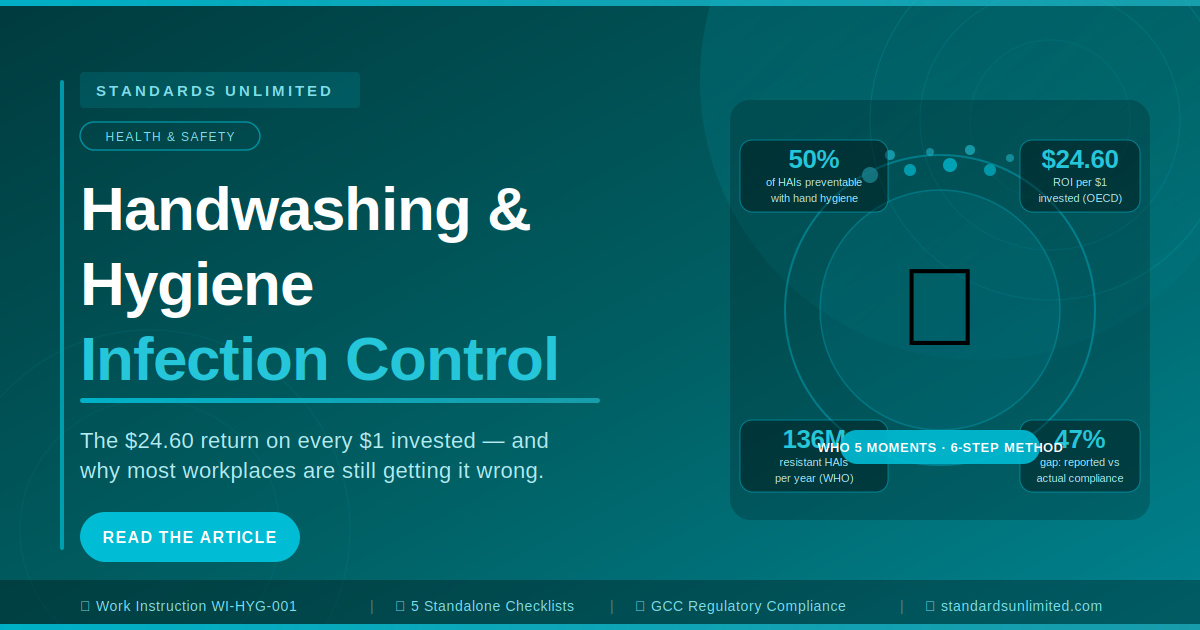
The case for hand hygiene has never been better documented. An OECD analysis across 34 countries found that every US$1 invested in improving hand hygiene in healthcare settings returns approximately US$24.60 in economic value — through reduced infections, lower treatment costs, and productivity gains. The WHO estimates that proper hand hygiene alone can prevent up to 50% of healthcare-associated infections. In October 2025, the WHO and UNICEF published their first-ever global Guidelines on Hand Hygiene in Community Settings — a landmark acknowledgement that hand hygiene belongs in every workplace, school, and public space, not only hospitals.
Yet despite this evidence, most organisations treat hygiene as an operational inconvenience rather than a safety-critical system. Compliance with hand hygiene protocols remains inconsistently low across virtually every sector. A 2024 study demonstrated a 47% discrepancy between workers’ self-reported hand hygiene compliance and what covert observation actually recorded. People believe they are washing their hands correctly and often enough. The evidence shows they are not.
The Scale of the Problem
Healthcare-associated infections affect 1 in 10 patients globally. According to a 2023 analysis by Balasubramanian et al., an estimated 136 million cases of healthcare-associated antibiotic-resistant infections occur worldwide every year. HAIs are among the most frequent adverse events in health service delivery — and antimicrobial resistance, which HAIs directly drive, is one of the WHO’s declared global health emergencies.
Beyond clinical settings, the picture is no less concerning. Gastrointestinal illness, respiratory infections, and foodborne disease cause billions of lost working days annually. The US National Foundation for Infectious Diseases State of Handwashing Report 2025, based on 3,587 respondents surveyed from all 50 US states, confirmed persistent gaps in both handwashing frequency and technique. The WHO’s 2025 new community hand hygiene guidelines note that 1.7 billion people still lacked basic hand hygiene services in 2024 — including 611 million with no handwashing facilities at all. In workplaces, the absence of soap, running water, or paper towels at accessible locations is not a minor inconvenience — it is a preventable transmission pathway.
Why the WHO 6-Step Method Exists — and Why Technique Matters
Most people wash their hands in a way that leaves significant areas unclean. Studies using UV-reactive gel consistently show that the backs of the hands, thumbs, and fingertips are routinely missed. A study by Aouthmany et al. found that workers’ confidence in their handwashing technique dropped significantly after seeing under UV light which areas they had actually missed. The backs of the hands, the thumbs, and the fingertips — the areas most frequently missed — are also the areas most frequently in contact with food, surfaces, and other people.
The WHO 6-Step method — covering all surfaces of both hands in a defined sequence — was developed precisely because unregimented handwashing leaves predictable blind spots. Performed correctly with soap and water for a minimum of 40–60 seconds, it achieves full coverage of both hands. Performed with alcohol-based hand rub (ABHR) for a minimum of 20–30 seconds, using the same technique, it achieves equivalent decontamination for most pathogens.
The method matters in the workplace for a second reason: it is auditable. A Hygiene Officer observing hand hygiene compliance can assess, against a defined standard, whether each of the eight technique steps was performed. Without a defined technique, “washing hands” could mean anything from a 3-second rinse under cold water to a full 60-second scrub. Only one of those protects against pathogen transmission.
The Four Most Common Hygiene Failures in Workplaces
1. Inadequate Facilities — No Soap, No Towels, Wrong Location
The WHO standard for high-risk settings is one accessible handwashing sink per 15 workers. Most general workplaces do not come close. Handwashing sinks positioned 50 metres from work areas will not be used during busy periods. Soap dispensers that run empty and are not restocked within hours create an effective handwashing blackout. Shared cloth towels in communal facilities are a cross-contamination vector — every worker who dries their hands on the same cloth transfers their hand microbiome to the next person who uses it.
The provision standard is non-negotiable: liquid soap in a pump or touch-free dispenser, single-use paper towels, a touch-free waste bin, and running water at every designated handwashing point — plus ABHR dispensers at every workstation and entry/exit point. These must be inspected and restocked every day, not when they run out.
2. Food Handlers Working While Ill
A single food handler with norovirus can infect dozens of colleagues and customers before their symptoms are recognised. Norovirus is detectable in faeces for up to 2 weeks after symptom resolution. The exclusion rule — 48 hours symptom-free before returning to food-handling work — exists for a reason that should be non-negotiable. Yet workplace cultures that penalise sick leave, pay structures that provide no income support for absence, and managers who pressure ill workers to attend all systematically undermine this control.
The rule must be explicit, enforced, and supported: any food handler experiencing diarrhoea, vomiting, jaundice, open skin lesions on hands or face, or active respiratory illness must not handle food. They must be excluded, paid appropriately for the absence, and not permitted to return until 48 hours symptom-free. This is not a guideline — it is a food safety requirement across all GCC jurisdictions.
3. ABHR Misconceptions
Alcohol-based hand rub is the WHO-recommended method for routine hand hygiene when hands are not visibly soiled — faster, more accessible, and equally effective for most pathogens. It is not a substitute for soap and water in all situations. ABHR is not effective against Clostridioides difficile (C. diff) or norovirus. In any situation involving these pathogens — confirmed or suspected — soap and water must be used.
A second common error is inadequate contact time. ABHR requires 20–30 seconds of active rubbing across all hand surfaces before hands are dry. Many workers apply a small amount of ABHR and wipe it off immediately, achieving no meaningful decontamination. The technique, not just the product, determines effectiveness.
4. No Compliance Monitoring
The Hawthorne effect — workers washing hands more when they know they are being observed — is well-documented in infection control research. A 2024 study found that self-reported hand hygiene compliance rates overstate actual compliance by nearly 47%. The only way to know real compliance rates is to observe them — using a structured observation tool, ideally with a mix of overt and covert observation, against defined moments (the WHO 5 Moments) and a defined technique standard (the WHO 6 Steps).
Monthly hand hygiene compliance observation, documented in a structured log, generates data that drives improvement. Organisations that monitor compliance and feed back the results to workers consistently achieve higher compliance rates than those that assume compliance is occurring because the policy says it should.
The GCC Dimension
The GCC’s hygiene landscape has three features that standard international templates do not address.
Heat and Humidity. GCC summer temperatures accelerate microbial growth on surfaces, in food, and on equipment. The food temperature danger zone (5–63°C) is reached almost immediately when food is taken outside refrigeration in summer ambient conditions. Sweating in hot conditions significantly increases skin bacterial load — outdoor workers returning to food preparation areas or welfare facilities carry higher bacterial counts than workers in temperate climates doing the same tasks. Hand hygiene frequency must be higher in GCC summer conditions.
Mandatory food safety certification. In the UAE, food handler health certificates and municipality-approved food safety training are mandatory legal requirements — not optional best practice. Dubai Municipality, Abu Dhabi ADAFSA, and Sharjah Municipality each operate a risk-based inspection system. Non-compliance results in fines, certificate suspension, or closure. UAE food safety training is tiered: Level 1 covers basic hygiene and personal conduct; Level 2 addresses food handling and cross-contamination; Level 3 covers supervisory HACCP and ISO 22000 awareness. Person In Charge (PIC) training is mandatory for management. Certificates must be renewed on schedule — typically every 1–3 years — and the employer is responsible for ensuring all certificates remain current.
Saudi Arabia’s SFDA operates equivalent requirements aligned with Codex Alimentarius. HACCP is the mandatory framework for Saudi food businesses, with personal hygiene for food handlers as a prerequisite programme. Saudi MOH’s GDIPC National Guide (Version 6, 2025) now sets IPC audit standards.
📥 Get the Complete Handwashing & Hygiene / Infection Control Document Pack
Everything described in this article is available to download from the Standards Unlimited store — ready to use, fully editable, and written to international standards with GCC-specific regulatory content built in.
Stop building from scratch. Use documents that are already done.
Five standalone checklists:
- Hygiene Inspection & Compliance Checklist
- Facility Hygiene & Cleaning Schedule
- Food Handler Medical & Training Record
- Hand Hygiene Compliance Observation Log
- Outbreak / Incident Response Log
Handwashing & Hygiene / Infection Control Work Instruction
Delivered as a fully formatted, editable .docx with cover page, logo placeholder, document control table, table of contents, and revision history.
🛒 Buy WI-HYG-001 — Work Instruction → (Replace # with your store product URL)
📋 Five Standalone Checklists — CL-HYG-001 to CL-HYG-005
Each checklist is a separate, professionally formatted .docx file with header, info fields, pass/fail columns, actions section, and three-role sign-off. All five are referenced in WI-HYG-001 Section 18. Buy individually or as a bundle.
CL-HYG-001 — Hygiene Inspection & Compliance Checklist Daily critical-item checks and weekly full inspection across 7 categories: handwashing facilities, food handler personal hygiene, surface and equipment hygiene, environmental hygiene, waste management, respiratory hygiene, and GCC-specific compliance (certificates, Food Watch, multilingual signage). 40+ inspection items.
CL-HYG-002 — Facility Hygiene & Cleaning Schedule A live daily cleaning log with Monday–Sunday sign-off columns, a weekly deep-clean task record, and a temperature monitoring log for all critical equipment (refrigerators, freezers, hot-hold units). Designed to satisfy municipality inspection requirements.
CL-HYG-003 — Food Handler Medical & Training Record Tracks medical fitness certificates (5 types), food safety training completion across all 3 UAE training tiers plus HACCP and refresher courses, and a full exclusion and return-to-work log. Essential for municipality audits in UAE, Saudi Arabia, Qatar, and across the GCC.
CL-HYG-004 — Hand Hygiene Compliance Observation Log A structured monthly audit tool built around the WHO 5 Moments — 30 observation rows across all five moments, a WHO 6-Step technique assessment section, and a compliance rate calculator. Addresses the 47% gap between reported and actual compliance.
CL-HYG-005 — Outbreak / Incident Response Log Activate immediately on 2+ related illness cases. Includes incident classification with severity rating, a 12-person case register, the full 7-step response checklist, a GCC regulatory notification log covering all six states, root cause analysis, and outbreak closure confirmation. Retention: 10 years minimum.
📊 Training Presentation — Handwashing & Hygiene / Infection Control (PowerPoint)
A 10-slide wide-format PowerPoint (13.3″ × 7.5″) in professional teal/dark theme. Slides cover: key statistics, WHO 5 Moments, WHO 6-Step technique + ABHR rules, food handler mandatory requirements, surface hygiene and facilities standards, GCC regulatory requirements (3 country panels), outbreak response (7-step), and the five records. Ready to deliver as a staff training session — no additional preparation needed.
🖼 Safety Poster — Handwashing & Hygiene (A3, Print-Ready JPG)
A professionally designed A3-format JPG poster (1587×2246px, 150 dpi) in teal/green colour scheme. Features the WHO 5 Moments visual, WHO 6-Step handwashing guide, ABHR rules with clear do/don’t indicators, food handler exclusion rule, GCC requirements panel, 5 checklist reference pills, and an outbreak alert. Post at every handwashing station, canteen, and first aid area.
💼 Complete Document Bundle — Best Value
Get everything in one purchase:
- ✅ WI-HYG-001 Work Instruction
- ✅ CL-HYG-001 through CL-HYG-005 (all 5 checklists)
- ✅ Training Presentation (PowerPoint)
- ✅ Safety Poster (A3 JPG)
💡 All documents are delivered as editable files. Add your company logo, update the document control fields, and they are ready to use. No reformatting. No starting from scratch.
🌍 GCC professionals: every document includes UAE, Saudi Arabia, Qatar, Oman, Bahrain, and Kuwait regulatory content — current as of 2025.
📩 Need a custom version or a topic not yet in our library? Contact us →
References
- WI-HYG-001 — Handwashing & Hygiene / Infection Control Work Instruction, Rev 01. Available at Standards Unlimited Store. 2025.
- CL-HYG-001 to CL-HYG-005 — Hygiene Record Forms. Available at Standards Unlimited Store. 2025.
- WHO Key Facts and Figures — World Hand Hygiene Day 2024 — 1 in 10 patients affected by HAIs; up to 50% preventable with hand hygiene; US$1 investment returns US$24.6 (OECD).
- Balasubramanian et al. 2023 (WHO cite) — 136 million cases of healthcare-associated antibiotic-resistant infections per year globally.
- WHO and UNICEF — New Guidelines on Hand Hygiene in Community Settings, October 2025 — First-ever global community hand hygiene guidelines; 1.7 billion people lacked basic hygiene services in 2024.
- NFID State of Handwashing Report 2025 — Survey of 3,587 US adults; persistent gaps in handwashing frequency and technique.
- Lau et al. 2024 (cited in PMC 12134553) — 47% discrepancy between observed and self-reported hand hygiene compliance rates.
- Aouthmany et al. (cited in PMC 12134553) — UV light study showing workers miss hand hygiene on backs of hands, thumbs, and fingertips.
- WHO Guidelines on Hand Hygiene in Health Care (2009, updated 2024) — WHO 5 Moments, WHO 6-Step method, ABHR standards.
- WHO Global Action Plan and Monitoring Framework on IPC 2024–2030 — Framework for national implementation; hand hygiene compliance monitoring as national indicator.
- WHO World Hand Hygiene Day 2025 — “SAVE LIVES: Clean Your Hands” campaign; gloves not a replacement for hand hygiene.
- CDC Hand Hygiene Guideline (updated 2024) — Alcohol-based hand rub for routine hygiene; soap/water for C. diff and norovirus.
- DAL: DNH 25-12, June 2025 (NY State) — ABHR 60-90% alcohol; soap and water 20 seconds; C. diff and norovirus require soap and water.
- UAE Federal Food Safety Law / UAE Food Code 2025 — Mandatory food safety certificate; HACCP and ISO 22000 benchmarks; municipality trade licence requirement.
- Dubai Municipality Food Safety 2025 — Risk-based inspection system; quarterly or bi-annual; fines, suspension, or closure for non-compliance.
- Abu Dhabi ADAFSA — Food Watch digital certificate system; food handler training levels 1–3 + PIC training.
- Saudi SFDA — Codex Alimentarius-aligned food safety standards; HACCP mandatory prerequisite programmes.
- Saudi MOH GDIPC National Guide for Auditors in Infection Control, Version 6, 2025 — IPC audit standards; APIC, CDC, WHO, GCC references.
- GCC-CIC Infection Control Manual (2nd edition) — Gulf Cooperation Council Centre for Infection Control — hand hygiene, aseptic practices, environmental hygiene for all GCC healthcare facilities.
- HACCP Guidance — Saudi Arabia, 2024 — Personal hygiene for food handlers as mandatory HACCP prerequisite.
- UAE Administrative Decision No. 19 of 2023 — 50+ employee hygiene obligations; high-risk task training.
- ISO 22000:2018 — Food Safety Management Systems incorporating HACCP and hygiene prerequisites.
- Codex Alimentarius — General Principles of Food Hygiene (2022 revision) — International food hygiene framework.
- OSHA 29 CFR 1910.1030 — Bloodborne pathogens standard — hand hygiene and PPE for occupational blood/fluid exposure.
- ISO 45001:2018 — Occupational Health and Safety Management Systems.
© 2026 SafetyDocs GCC. All rights reserved. Always verify compliance with the relevant municipal authority and health regulator in your specific GCC jurisdiction.