Annex A is the part of ISO/IEC 27001 that most people picture when they think of the standard: a long list of security controls. It is also the part most often misunderstood. Organisations either try to implement every control as a checklist, or they tick ‘Yes’ against all 93 in a Statement of Applicability and hope the auditor does not ask what sits behind each tick.
This guide explains how Annex A is organised in the 2022 edition, which controls are new, what auditors actually look for, and how to use Annex A the way the standard intends: as a reference list you compare your risk treatment against.
What Annex A is, and what it is not
ISO/IEC 27001:2022 has two parts. Clauses 4 to 10 set out the management system requirements, and every one of them is mandatory. Annex A is a normative list of 93 information security controls, aligned with the guidance in ISO/IEC 27002:2022.
Annex A is not a list of controls you must implement. Clause 6.1.3 asks you to:
- determine the controls you need to treat your information security risks, from any source;
- compare those controls with Annex A to verify that no necessary control has been overlooked; and
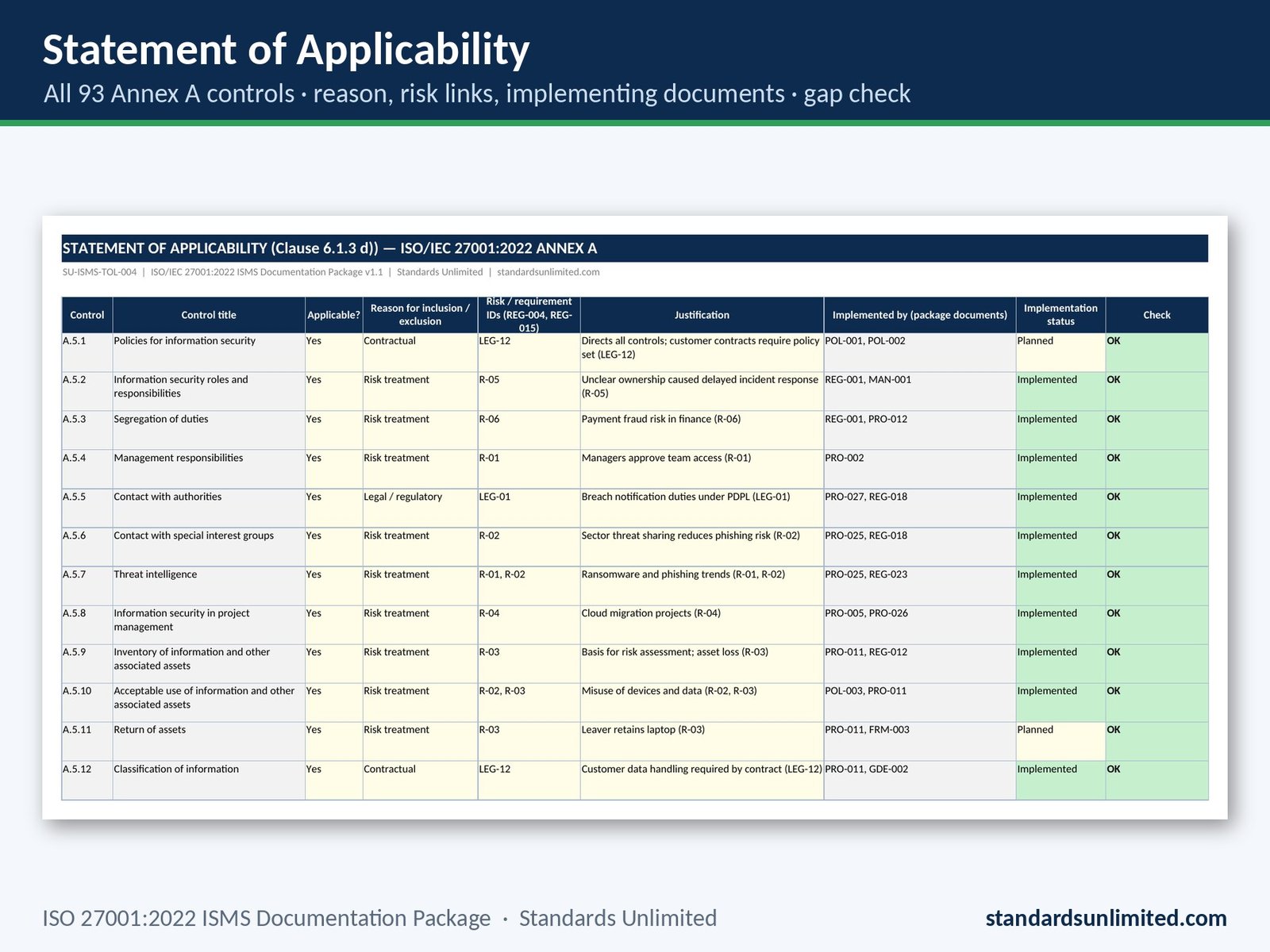
- produce a Statement of Applicability (SoA) that lists the necessary controls, the justification for including them, whether they are implemented, and the justification for excluding any Annex A control.
In other words, the risk assessment decides which controls you need. Annex A is the safety net that checks you have not missed one.
The four themes: 93 controls at a glance
The 2022 edition replaced the 14 domains and 114 controls of the 2013 version with four themes:
| Theme | Controls | What it covers | Examples |
|---|---|---|---|
| A.5 Organisational | 37 (A.5.1–A.5.37) | Policies, roles, assets, access, suppliers, incidents, continuity, compliance | Policies for information security, access control, supplier agreements, incident management, legal requirements |
| A.6 People | 8 (A.6.1–A.6.8) | Controls that depend on individuals, before, during and after employment | Screening, awareness and training, confidentiality agreements, remote working, event reporting |
| A.7 Physical | 14 (A.7.1–A.7.14) | Premises, equipment and media | Physical entry, clear desk and screen, equipment maintenance, secure disposal |
| A.8 Technological | 34 (A.8.1–A.8.34) | Technical controls across endpoints, networks, systems and development | Secure authentication, malware protection, backup, logging, network security, secure development, change management |
ISO/IEC 27002:2022 also gives every control five attributes, so you can sort and filter them: control type (preventive, detective, corrective), information security properties (confidentiality, integrity, availability), cybersecurity concepts (identify, protect, detect, respond, recover), operational capabilities and security domains. These attributes are optional, but they are useful when you map Annex A to other frameworks such as NIST CSF or a national cybersecurity standard.
The 11 controls that are new in 2022
Most 2022 controls were carried over, merged or renamed from the 2013 edition. Eleven are new, and auditors pay close attention to them:
| Control | Title | What it means in practice |
|---|---|---|
| A.5.7 | Threat intelligence | Collect and analyse threat information relevant to you, and act on it |
| A.5.23 | Information security for use of cloud services | Govern how you acquire, use, manage and exit cloud services |
| A.5.30 | ICT readiness for business continuity | Plan and test ICT recovery against your continuity objectives |
| A.7.4 | Physical security monitoring | Monitor premises for unauthorised physical access |
| A.8.9 | Configuration management | Define, apply and monitor secure configurations |
| A.8.10 | Information deletion | Delete information when it is no longer required |
| A.8.11 | Data masking | Mask sensitive data, such as personal data, where policy requires |
| A.8.12 | Data leakage prevention | Detect and prevent unauthorised disclosure of information |
| A.8.16 | Monitoring activities | Monitor networks and systems for anomalous behaviour |
| A.8.23 | Web filtering | Manage access to external websites to reduce exposure to malicious content |
| A.8.28 | Secure coding | Apply secure coding principles where you develop software |
The transition period for ISO/IEC 27001:2013 certificates ended on 31 October 2025, so every certified ISMS is now assessed against these controls. If your SoA still lists 114 controls in 14 domains, it needs rebuilding.
What an auditor looks for against Annex A
An auditor does not audit Annex A as a list. They audit your SoA, then sample the controls you have declared as implemented. For each sampled control, expect three questions:
- Why is this control in your SoA? The justification should point to a risk in your risk register, a legal or regulatory requirement, a contract, or a business requirement. ‘Best practice’ alone is weak.
- Where is it defined? The auditor will ask which policy, procedure or standard implements the control. If your SoA names a document, that document must actually address the control.
- Show me it working. Records are the evidence: an access review, a restore test, a patching report, a supplier assessment, a training record.
A useful test: pick any five ‘Implemented’ controls in your SoA and try to produce the policy text and one record for each within ten minutes. If you cannot, neither can your auditor.
Five common Annex A mistakes
- Starting with Annex A instead of risk. Controls should follow from the risk assessment. Building the SoA first and the risk register afterwards is easy for an auditor to spot.
- Generic justifications. ‘Required for security’ is not a justification. Link each control to risk IDs, legal requirements or contract clauses.
- Excluding controls that are clearly relevant. Excluding A.8.31 (separation of environments) while testing changes in a SaaS sandbox, or A.8.4 (access to source code) while maintaining scripts and website code, will be challenged.
- No topic-specific policies. A.5.1 now expects topic-specific policies, for example on access control, cryptography, backup and remote working, as well as the top-level policy.
- Treating the SoA as a one-off. The SoA must be reviewed and updated whenever the risk assessment, the scope or the controls change, and it has a version number the certificate refers to.
How to build a Statement of Applicability that holds up
A defensible SoA has, for every one of the 93 controls:
- applicability (Yes or No);
- the reason for inclusion or exclusion (risk treatment, legal, contractual or business requirement);
- the risk or requirement IDs it traces to;
- the document or system that implements it;
- the control owner and implementation status; and
- where the evidence is kept.
Approve it at top management level, give it a version number, and review it at least annually. For the risk side, our ISO 27001 risk assessment guide walks through criteria, scoring and treatment, and the ISO 27001:2022 checklist covers the path to certification.
Frequently asked questions
Do we have to implement all 93 Annex A controls?
No. You implement the controls your risk assessment, legal and contractual requirements call for. You must still consider every Annex A control and justify any exclusion in the SoA.
Can we add controls that are not in Annex A?
Yes. Annex A is not exhaustive. Controls from other frameworks or your own design can be included in your risk treatment and SoA.
Is ISO/IEC 27002 mandatory?
No. ISO/IEC 27002:2022 is guidance on implementing the controls. It is very useful, but certification is against ISO/IEC 27001 only.
Every Annex A control, mapped and ready to implement
The ISO 27001:2022 Documentation Package gives you 76 editable Word and Excel files. It includes a Statement of Applicability for all 93 controls, with each applicable control mapped to a policy, procedure or register that implements it. You also get 16 topic-specific policies, a risk toolkit with acceptance criteria, a 140-question audit checklist and a certification readiness workbook. Reviewed by an IRCA Lead Auditor.
Add to Cart — $149 launch price See what’s included
Using AI as well? The Security & AI Governance Bundle adds the ISO 42001 AI management system package: 177 templates for $279.