
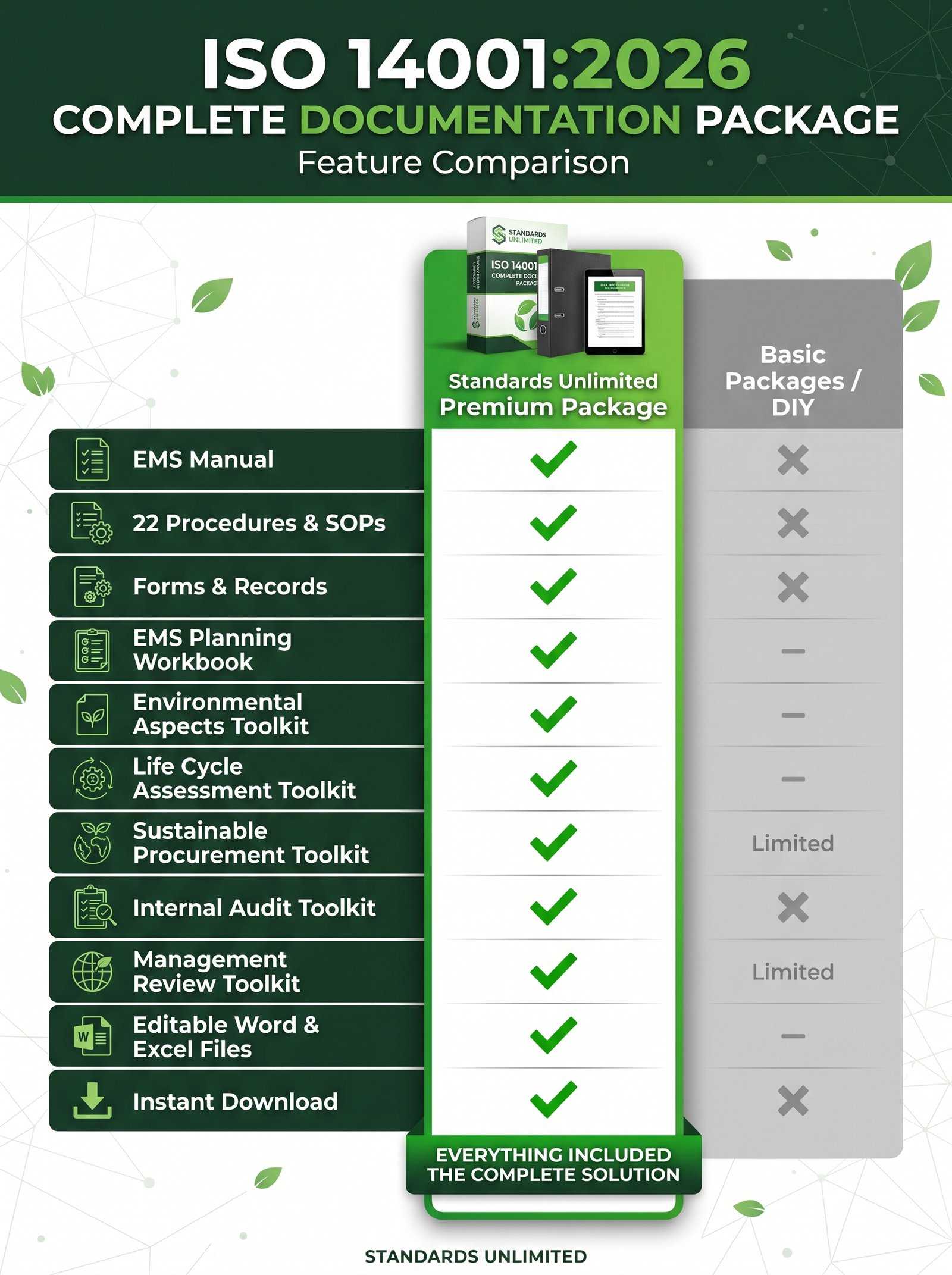
ISO 14001:2026 Documentation Package – 67 Editable EMS Templates + Welcome Guide (Word & Excel)
Original price was: $199.00.$149.00Current price is: $149.00.
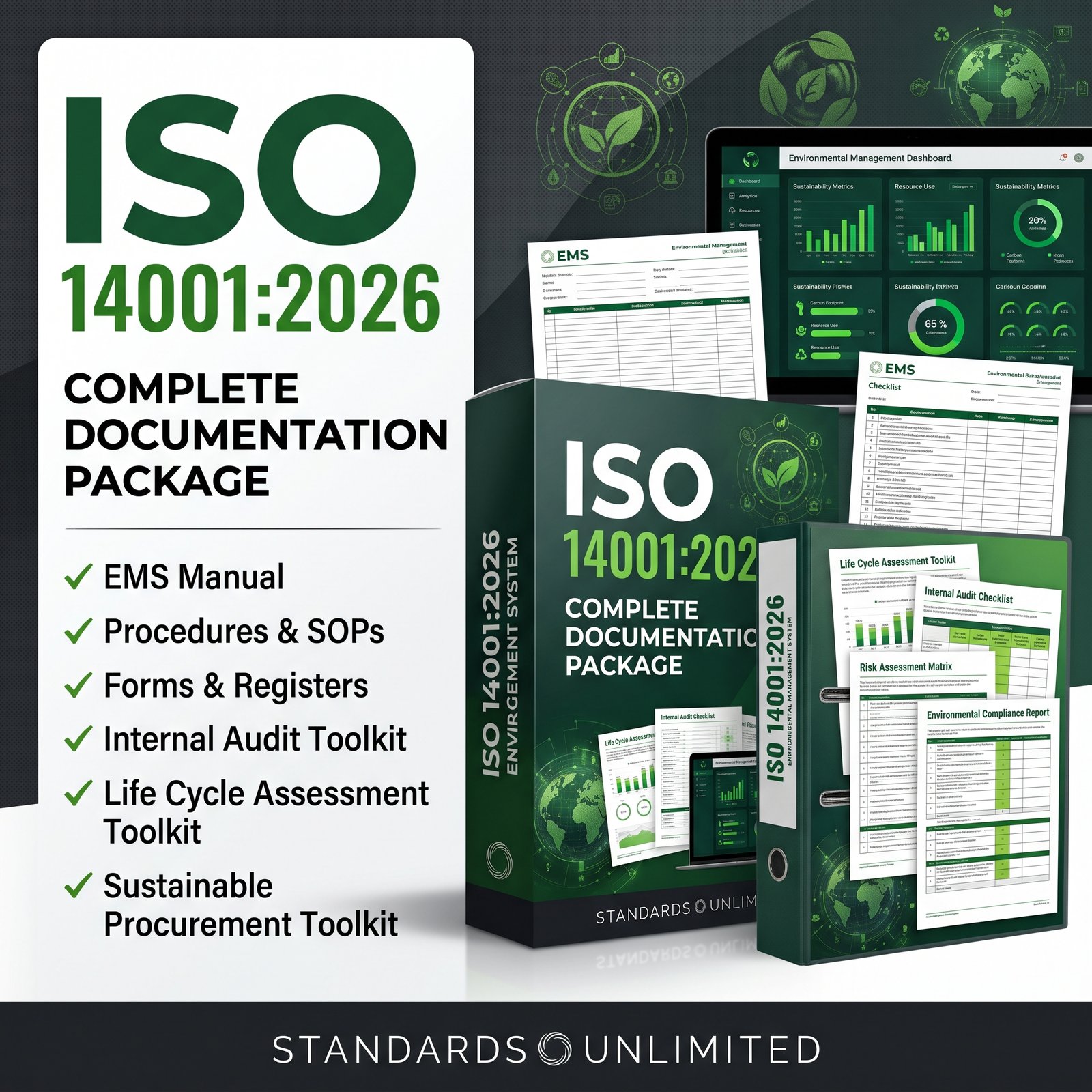
Build or transition your Environmental Management System to ISO 14001:2026 without starting from a blank page. This package gives you 67 editable Word and Excel documents and tools plus a Welcome Guide — EMS manual, policy, scope, 21 procedures, 7 SOPs, an emergency response plan, completable forms, a linked Master EMS Planning and Risk Workbook, and full internal audit and management review toolkits. Written by a practising certification auditor, with worked examples and UAE/GCC legal examples. Instant download.
- ✔ Built for ISO 14001:2026 (published April 2026) — first certification or transition from 2015
- ✔ A4, fully editable Word & Excel — rebrand and renumber freely
- ✔ Formula-driven aspect significance and compliance tracking
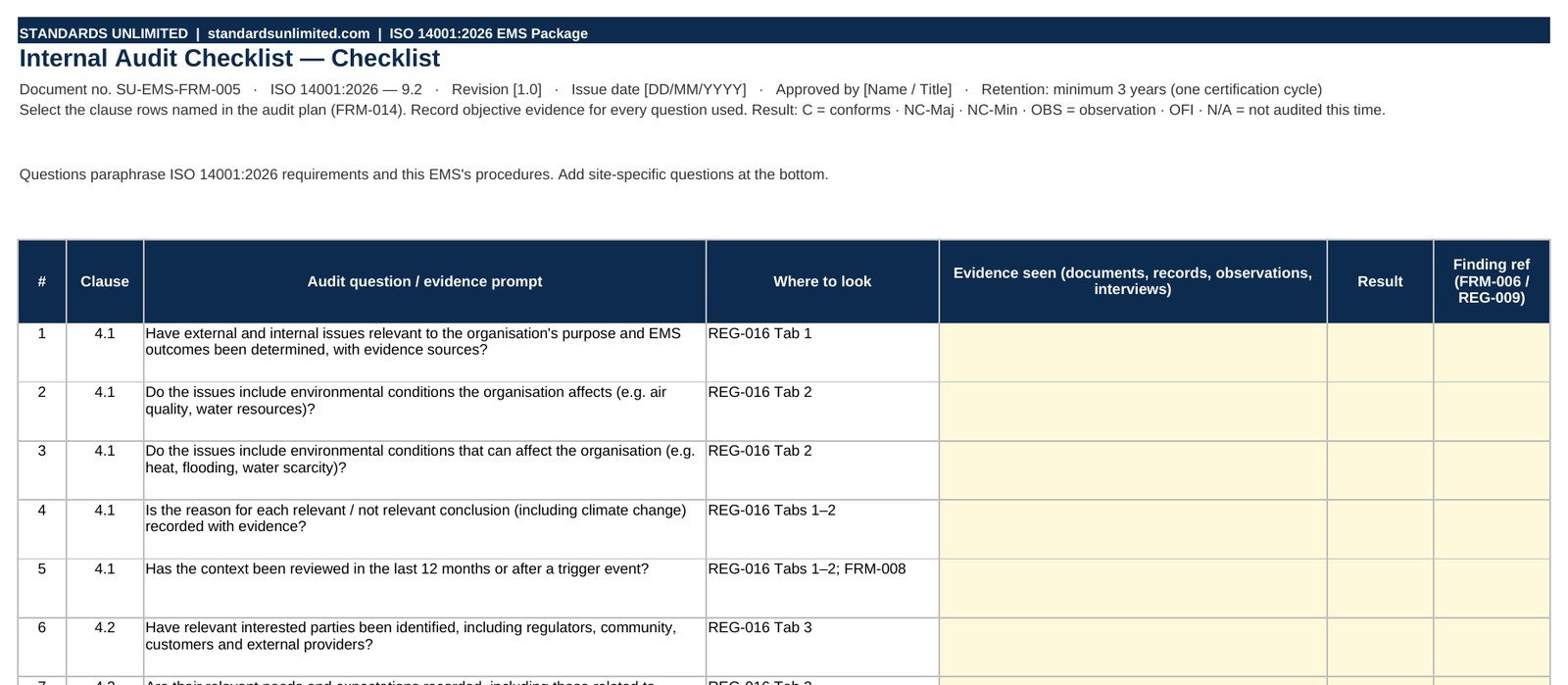
- ✔ 110-question internal audit checklist
Already certified to ISO 14001:2015? You may only need the ISO 14001:2026 Transition Package — 27 templates focused on what changed.
Approx. AED 547 · Invoice available on request · Instant download
Need ISO 9001 and ISO 45001 too? Get all three packages in the IMS Bundle — 123 templates for $299 (save $148). Working on the SDGs? Pair it with ISO/UNDP 53001 in the Sustainability Bundle — $229.
Not ready yet? Start with our free ISO 14001 environmental aspects register template.
Description
Certification-ready ISO 14001:2026 EMS documentation — with a clear 10-step route to certification
What it is. A complete, structured set of EMS documents and tools covering every clause of ISO 14001:2026, from context (4.1) to corrective action (10.2). Add an environmental aspect once and it carries through to your legal register, operational controls, emergency plan, objectives and audit checklist — no copying between files, no gaps for an auditor to find.
Who it is for. Environmental and QHSE managers, consultants and SMEs that need an EMS certified for the first time, and certified organisations that must move from ISO 14001:2015 to the 2026 edition.
Why it saves time. Writing an EMS from scratch typically takes weeks of drafting and rework. Here the structure, wording, clause mapping and spreadsheet logic are already done. You replace the example data with your own sites, activities and obligations, and spend your time on implementation rather than formatting.
Certification benefits. The package is designed around what a certification auditor asks to see at Stage 1 and Stage 2: a defined scope, documented significance criteria, a compliance evaluation trail, operational controls for significant aspects, tested emergency arrangements, an audit programme with evidence that it was carried out, and management review records that cover the 2026 inputs (9.3.2) and results (9.3.3). Using it does not guarantee certification — that depends on your implementation — but it removes the documentation gaps auditors most often raise.
Transition window open now – plan before your next surveillance audit. ISO 14001:2015 certificates must move to the 2026 edition within the transition period. Certification bodies currently report the end date as 30 April 2029 — confirm yours with your certification body.
| ✔ What this is | ✘ What this isn’t |
|---|---|
| A complete, editable ISO 14001:2026 EMS documentation set: manual, policy, procedures, SOPs, forms, registers and audit tools | A copy of the ISO 14001 standard — buy that from ISO or your national standards body |
| Written and checked against the published 2026 text, with clause references in every document | A certificate or a guarantee of certification — your certification body audits your implemented system |
| Worked examples that show how the documents connect | A finished EMS — you replace the example data with your own sites, aspects and obligations |
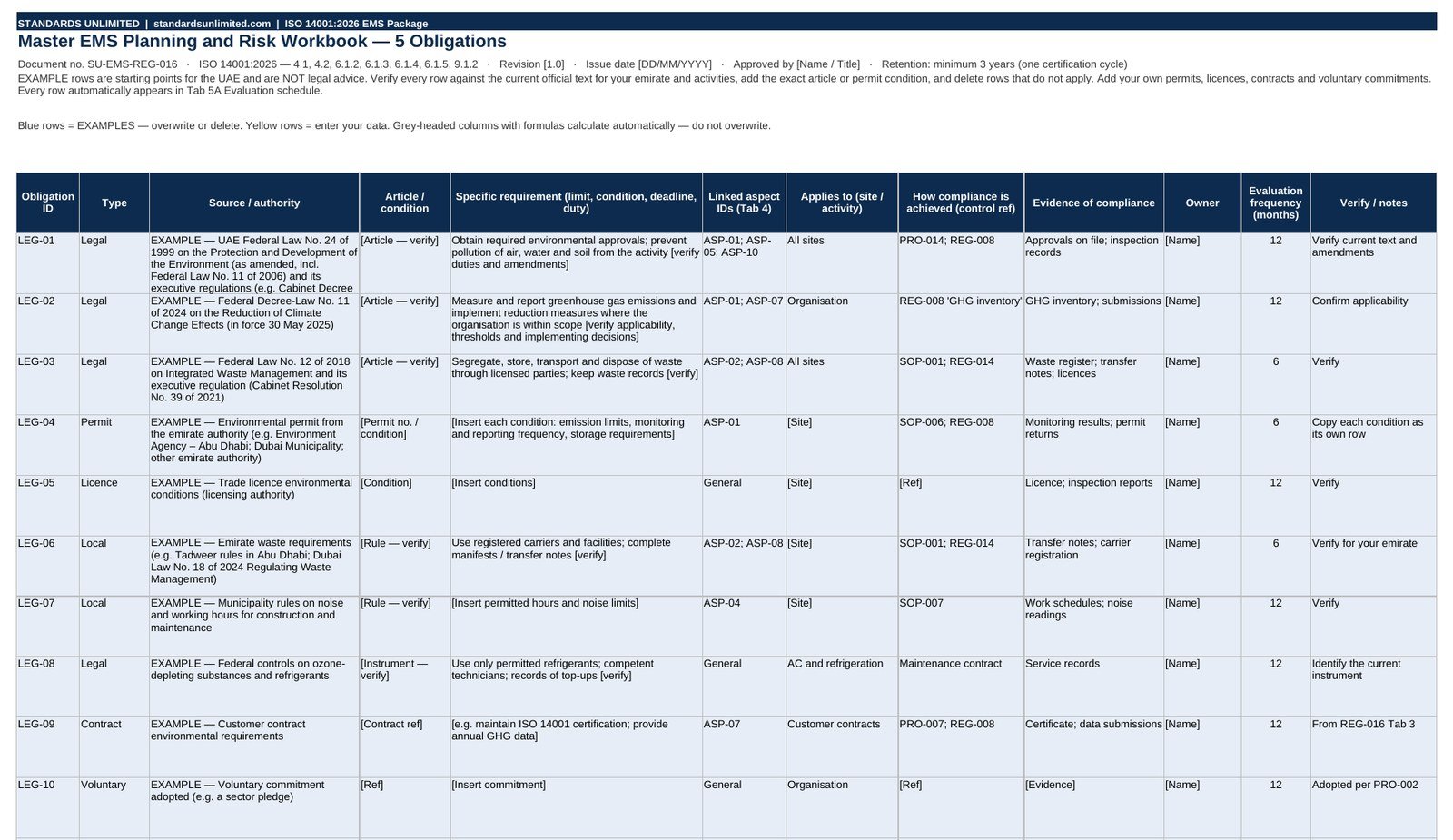
| A starting point for your legal register, with UAE examples marked “verify” | Legal advice or a complete legal register for your sites |
| Independent work by Standards Unlimited | Affiliated with ISO or any certification body |
Already certified to ISO 14001:2015?
You don’t need to rebuild your EMS. ISO 14001:2026 keeps the same harmonised structure, so your scope, procedures and records stay valid. You update what the revision changed — and this package shows you exactly what that is.
Start with these documents:
- Gap Analysis Tool (Excel, with dashboard) — compare your current EMS clause by clause and get an action list. The Start Here guide lists every 2026 change and the documents that address it.
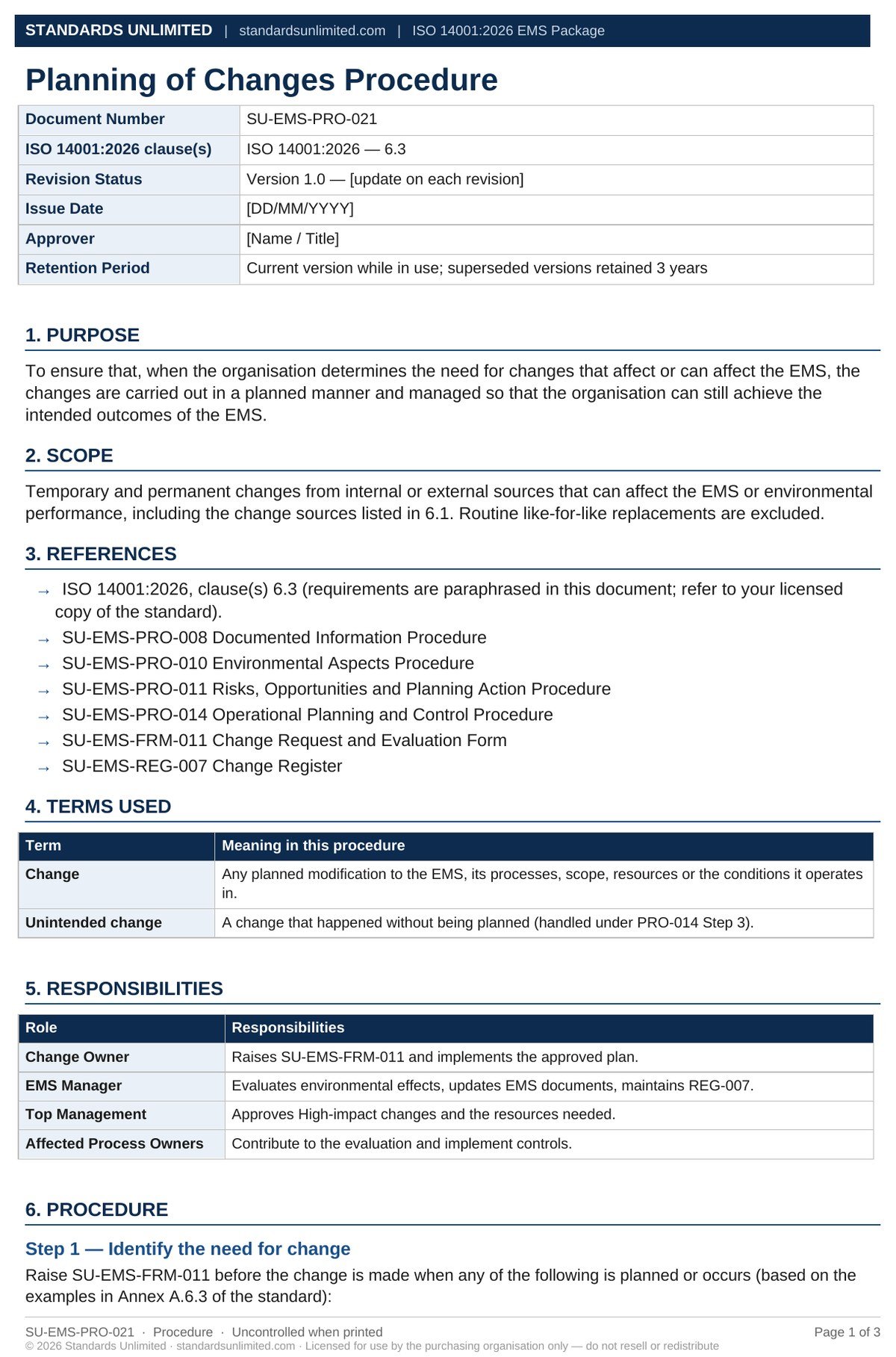
- Planning of Changes Procedure, Change Request Form and Change Register — the new clause 6.3 requirement.
- Emergency scenarios, Emergency Response Plan and Incident Report Form — potential emergency situations must now be determined under 6.1.2.
- Risks and opportunities procedure and register — now a separate subclause, 6.1.4.
- Life cycle and value chain controls, Sustainable Design Guideline and Life Cycle Assessment Form — the strengthened life cycle perspective in 8.1.
- External Provider Evaluation Form and Register — “externally provided” processes replace “outsourced”.
- Internal Audit Plan — audit objectives must now be defined for each audit (9.2.2).
- Management Review Minutes — restructured inputs (9.3.2) and results (9.3.3).
Compatible with your existing EMS. Use these documents as a guide to update your own, or adopt them where yours are weaker. Every document cites its clauses, so you can map it against your current numbering. The rest of the package is there if you also want to refresh your registers, forms or procedures.
What’s new in ISO 14001:2026 — and how this package covers it
| 2026 change | How the package handles it |
|---|---|
| Context must include environmental conditions the organisation affects or is affected by (4.1) | Context procedure and Planning Workbook context and environmental conditions tabs |
| Potential emergency situations must now be determined as part of 6.1.2 | Emergency scenarios linked to emergency aspects; Emergency Response Plan and Incident Report Form |
| Risks and opportunities become a separate subclause (6.1.4) | Risks and opportunities procedure and Planning Workbook risk tabs |
| Planning of changes (6.3) | Planning of Changes Procedure, Change Request Form and Change Register |
| “Externally provided” processes replace “outsourced”; note on the hierarchy of controls (8.1) | Operational control procedure, scored External Provider Evaluation Form and External Provider Register |
| Audit objectives defined for each audit (9.2.2) | Internal Audit Procedure and Internal Audit Plan |
| Management review restructured (9.3.2 inputs, 9.3.3 results) | Management Review Procedure and Management Review Minutes follow the 2026 order and wording |
| Clause 10 renumbered: 10.1 Continual improvement, 10.2 Nonconformity and corrective action | Separate procedures for each, with a shared nonconformity and improvement log |
| Updated terminology (“meet”, “externally provided”, removed risk definition) | Applied consistently in all documents |
Why choose this package?
- Written for the 2026 edition, not relabelled from 2015. Clause numbers, titles and terminology were checked against the published ISO 14001:2026 text. There is no obsolete clause 10.3 and no “outputs” where the standard now says “results”.
- One entry, everywhere it’s needed. Add an aspect once and it flows into your legal register, controls, emergency scenarios, risks and objectives. Built-in checks flag broken links, unscored aspects and overdue actions before your auditor does.
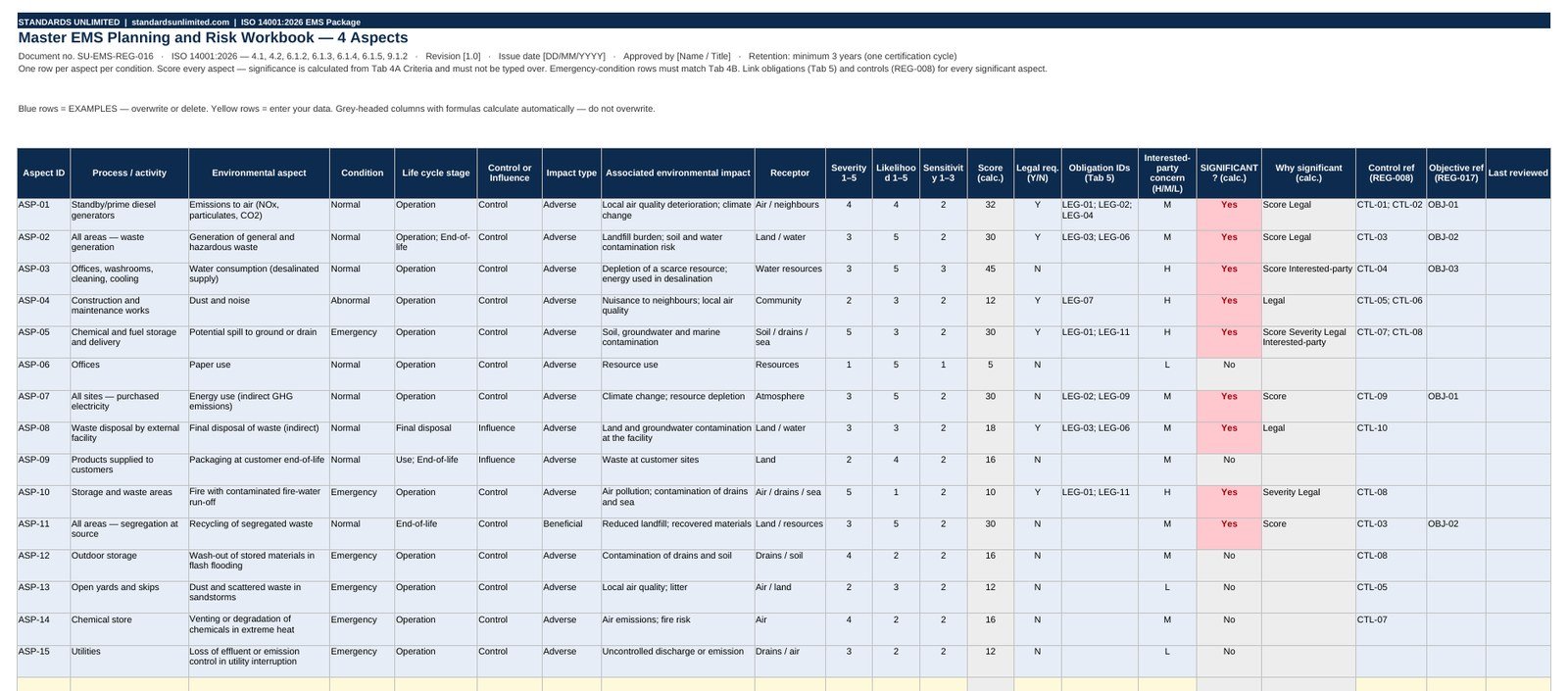
- No auditor will challenge why a fire risk scored low. Severity × Likelihood × Sensitivity scoring with a severity-5 override means rare but serious events are always significant. Legal and interested-party rules are built in, and the result is calculated, not typed.
- Records your auditor accepts on day one. Every form has real fields, sign-offs and instructions, so the evidence you generate is complete from the first use.
- GCC-ready. Example legal register rows for UAE federal and emirate-level requirements (clearly marked EXAMPLE — verify), plus GCC-relevant emergency scenarios.
- Professional finish. A4 page setup, consistent document numbering, branded headers and footers, a Welcome Guide and a Start Here guide with a 10-step implementation route and full clause map.
- Make it yours in minutes. Every file can be rebranded with your logo and renumbered to your own document scheme. Change headers, footers, codes and colours freely — the requirement is the content, not the format.
Who built it and how it was checked
Written by a practising certification auditor. This package was developed by an IRCA-certified Lead Auditor with more than 24 years of QHSE experience, certified across 11+ international management system standards and an approved ISO trainer. It is written the way auditors read an EMS: what the clause requires, what evidence shows it, and where organisations usually fall short.
Reviewed against seven audit-critical areas. Before release, the package went through a strict review of the areas where Stage 2 nonconformities are most common: environmental aspects, compliance obligations, operational controls, emergency preparedness, monitoring, internal audit evidence and management review evidence. The issues found were fixed in the rebuilt version.
Tested, not just written. 1,255 spreadsheet formulas were recalculated with zero errors and deliberately tested with broken links, unscored aspects and overdue actions to confirm the checks catch them. Every clause reference was validated against the published ISO 14001:2026 text.
What’s included
Start here
- Welcome Guide — what is in the package, implementation roadmap, document structure, how to customise, recommended sequence for new certification and transition, and support.
- Start Here guide — 10-step implementation route, 2026 change summary, full clause map and complete file list.
EMS Manual, policy and scope
- Environmental Management System Manual (MAN-001) — how your EMS meets each clause, with a process interaction map.
- Environmental Policy (POL-001) — covers the commitments required by 5.2, ready for top-management sign-off.
- EMS Scope Statement (SCP-001) — boundaries, applicability, sites, activities, products and services (4.3).
21 EMS procedures (PRO-001 to PRO-022)
Context of the organisation · Interested parties · Leadership, commitment and resources · Roles, responsibilities and authorities · Competence and training · Awareness · Communication · Documented information · Environmental aspects · Risks, opportunities and planning action · Compliance obligations · Evaluation of compliance · Operational planning and control (including life cycle and value chain) · Emergency preparedness and response · Monitoring, measurement, analysis and evaluation · Internal audit · Management review · Nonconformity and corrective action · Continual improvement · Planning of changes · Environmental objectives and planning.
7 SOPs and plans
- SOPs (SOP-001 to SOP-007) — waste segregation, storage and disposal · spill response · contractor environmental control · energy and water monitoring · chemical storage and handling · generator and air emissions control · dust and noise control. Use them as your work instructions or as models for site-specific ones.
- Environmental Emergency Response Plan (ERP-001) — scenarios, roles, response steps, drills and post-incident review.
- Environmental Awareness Briefing Pack (AWR-001) (7.3).
- Sustainable Design and Development Guideline (GUI-001).
14 completable forms
Compliance evaluation record · Monitoring and measurement log · Training and briefing attendance record · Internal audit report · Nonconformity and corrective action report · Management review minutes · Emergency drill report · Competence evaluation record · Change request and evaluation form · Environmental incident report · External provider environmental evaluation form · Internal audit plan · Site environmental inspection checklist · Life cycle environmental assessment form.
11 Excel registers
- Master EMS Planning and Risk Workbook (REG-016) — see below.
- Environmental Objectives and KPI Action Tracker (REG-017) — objectives, action plans, progress log and summary; overdue steps flagged automatically.
- Operational Control and Monitoring Plan (REG-008) — controls, monitoring plan, calibration register, KPI data, dashboard and GHG inventory (you enter your own emission factors and their source).
- Change register · Nonconformity, corrective action and improvement log · Master list of documented information and retention schedule · Competence and training matrix · Communication plan and log · Waste register and chemical inventory · External provider register · Roles, responsibilities and authorities matrix.
Internal Audit Toolkit
- Internal Audit Programme (AUD-001) — programme, implementation record and 3-year cycle.
- Internal Audit Checklist (FRM-005) — 110 clause-by-clause ISO 14001:2026 questions in Excel, with a summary.
- Internal Audit Plan (FRM-014) and Internal Audit Report (FRM-006), including audit objectives, distribution to management and follow-up of earlier findings.
Management Review Toolkit
- Management Review Minutes (FRM-008) — structured on the 2026 inputs (9.3.2) and results (9.3.3).
- Management Review Action Tracker (MRT-001) — tracks every review action to closure.
Risk & Opportunity Assessment Tools
Inside the Master EMS Planning and Risk Workbook: risks and opportunities register, assessment method and summary. Each risk or opportunity is linked to its source — a context issue, environmental condition, aspect or compliance obligation — and the workbook flags any source that does not exist.
Environmental Aspect Assessment Tools
Inside the Master EMS Planning and Risk Workbook: aspects register, significance criteria, emergency scenarios, life cycle stages, an aspect library to start from, and an aspect summary. Control/influence and life cycle stage are recorded for every aspect, upstream and downstream as well as on site.
Life Cycle Assessment Toolkit
A practical life cycle perspective toolkit for 6.1.2 and 8.1: the operational control procedure’s life cycle and value chain controls, the Sustainable Design Guideline, the Life Cycle Environmental Assessment Form and the Planning Workbook life cycle tab. (This supports the life cycle perspective ISO 14001 requires; it is not a quantitative ISO 14040/14044 LCA study.)
Sustainable Procurement Toolkit
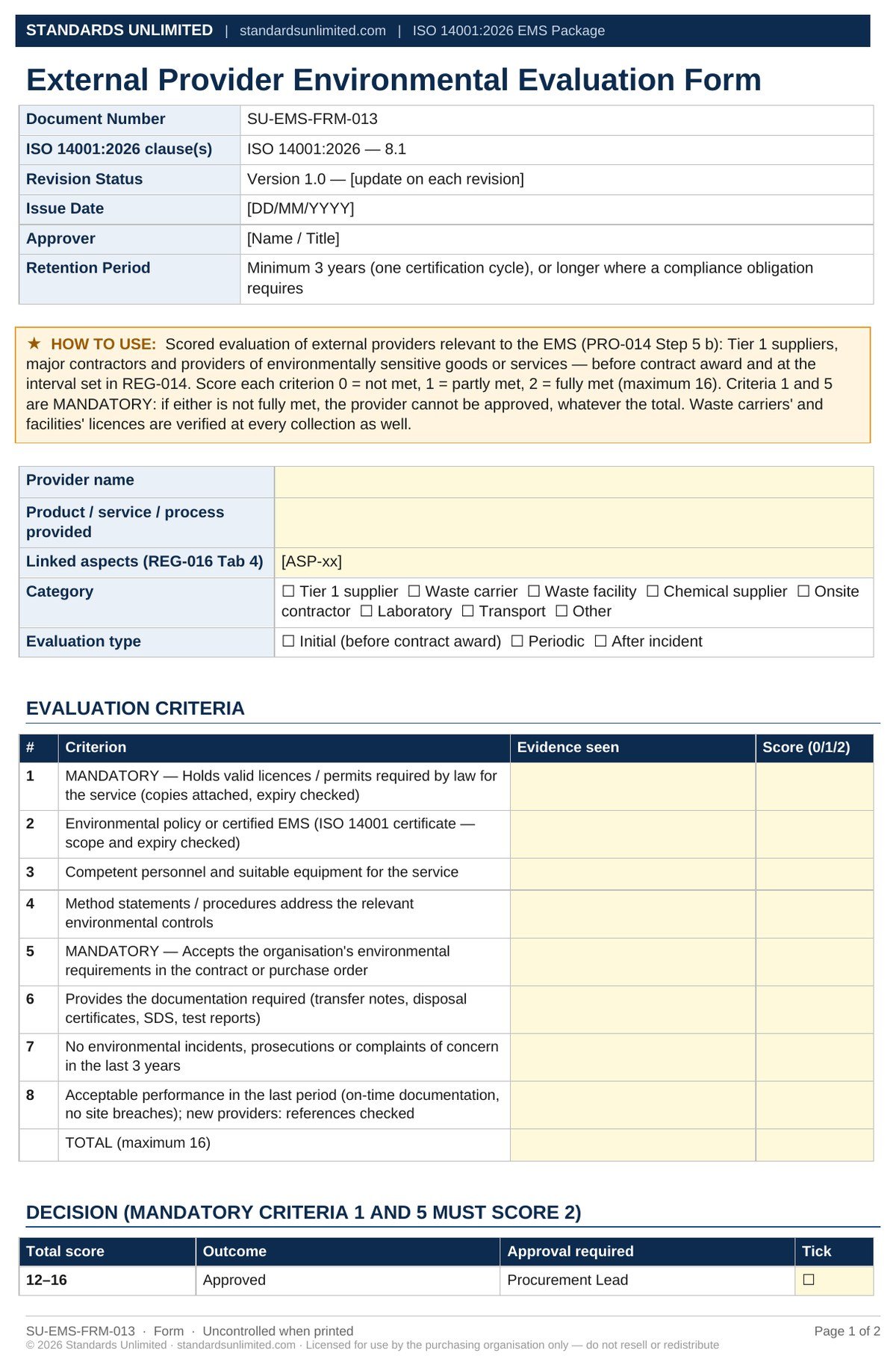
- External Provider Environmental Evaluation Form (FRM-013) — scored 0–16, with mandatory criteria (valid licence and acceptance of your environmental requirements): 12–16 approved; 7–11 approved with a mitigation plan; 0–6 not approved without written top-management acceptance.
- External Provider Register (REG-014) with statuses that match the evaluation outcomes.
- Contractor Environmental Control SOP and environmental requirements for purchasing in the operational control procedure.
Master EMS Planning and Risk Workbook
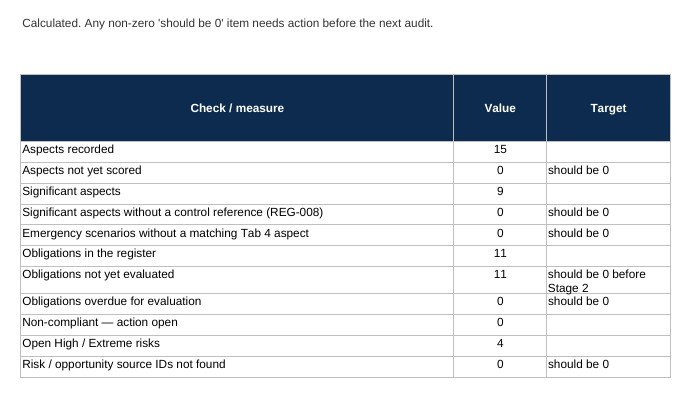
REG-016 — one linked Excel file with 18 tabs: Contents, Context, Environmental conditions, Interested parties, Aspects, Criteria, Emergency scenarios, Life cycle, Aspect library, Aspect summary, Obligations, Evaluation schedule, Compliance status, Update log, Risks & opportunities, R&O method, R&O summary and Planning summary. The planning summary shows integrity counts that should all read zero — a quick self-check before your audit.
Implementation tools
- Gap Analysis Tool (TMP-001) — clause-by-clause gap analysis with dashboard.
- EMS Implementation Project Plan (TMP-002) — Gantt-style plan.
- Certification Readiness Checklist (TMP-004) — final check before Stage 1.
- Implementation Roadmap (TMP-005) — six phases with typical timings and outputs.
Everything above, in one download — 67 editable Word and Excel documents and tools, plus a Welcome Guide.
Add to Cart — Instant Download
One-time payment · Rebrand and renumber freely · Approx. AED 547
Every clause covered — see for yourself
Each clause of ISO 14001:2026 maps to at least one document. This is a summary of the clause map in the Start Here guide.
| Clause | Requirement | Documents in this package |
|---|---|---|
| 4.1 | Context of the organisation | Context procedure; Planning Workbook context and environmental conditions tabs |
| 4.2 | Interested parties | Interested parties procedure; Planning Workbook interested parties tab |
| 4.3 | Scope | EMS Scope Statement |
| 4.4 | EMS and its processes | EMS Manual with process map |
| 5.1 | Leadership and commitment | Leadership, commitment and resources procedure |
| 5.2 | Environmental policy | Environmental Policy |
| 5.3 | Roles, responsibilities and authorities | Roles procedure; roles and authorities matrix |
| 6.1.1–6.1.5 | Risks and opportunities, aspects, compliance obligations, planning action | Aspects, compliance obligations and risks procedures; Planning Workbook aspects, obligations and risk tabs |
| 6.2 | Environmental objectives | Objectives procedure; Objectives and KPI Action Tracker |
| 6.3 | Planning of changes | Planning of Changes Procedure; Change Request Form; Change Register |
| 7.1–7.4 | Resources, competence, awareness, communication | Resources, competence, awareness and communication procedures; competence matrix; competence evaluation; Awareness Briefing Pack; attendance record; communication plan and log |
| 7.5 | Documented information | Documented Information Procedure; master list and retention schedule |
| 8.1 | Operational planning and control | Operational control procedure; 7 SOPs; Sustainable Design Guideline; control and monitoring plan; waste and chemical register; external provider register and evaluation form; life cycle assessment form |
| 8.2 | Emergency preparedness and response | Emergency procedure; Emergency Response Plan; spill response SOP; drill report; incident report |
| 9.1.1 | Monitoring, measurement, analysis and evaluation | Monitoring procedure; control and monitoring plan; monitoring log |
| 9.1.2 | Evaluation of compliance | Evaluation of compliance procedure; Planning Workbook obligations tabs; compliance evaluation record |
| 9.2 | Internal audit | Internal audit procedure; programme; plan; 110-question checklist; report |
| 9.3 | Management review | Management review procedure; minutes; action tracker |
| 10.1 | Continual improvement | Continual improvement procedure; improvement log |
| 10.2 | Nonconformity and corrective action | Nonconformity and corrective action procedure; report; log |
Package deliverables
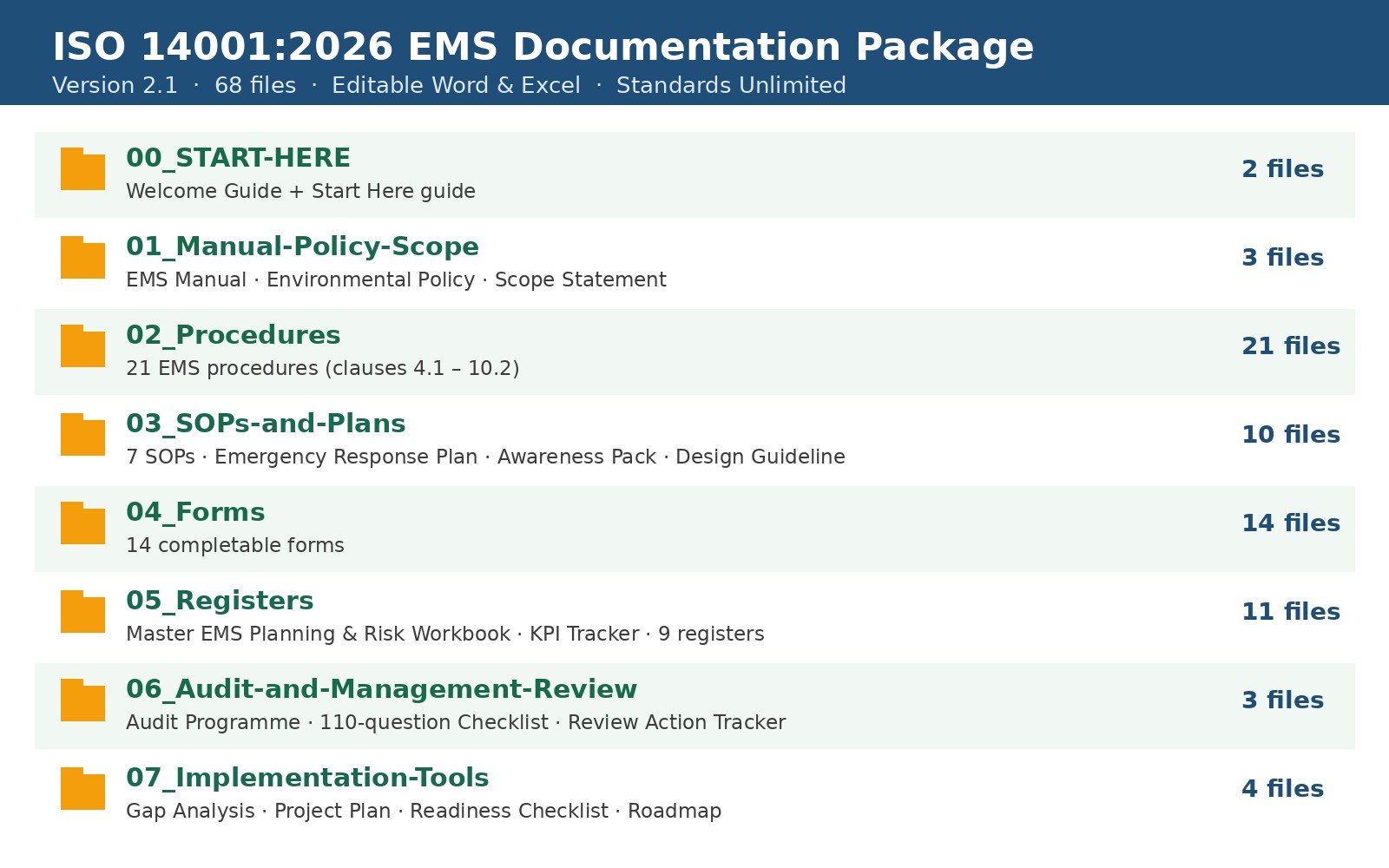
| Folder | What’s inside | Format | Files |
|---|---|---|---|
| 00 Start Here | Welcome Guide and Start Here guide (route, 2026 changes, clause map, file list) | Word | 2 |
| 01 Manual, Policy, Scope | EMS Manual, Environmental Policy, EMS Scope Statement | Word | 3 |
| 02 Procedures | 21 EMS procedures | Word | 21 |
| 03 SOPs and Plans | 7 SOPs, Emergency Response Plan, Awareness Briefing Pack, Sustainable Design Guideline | Word | 10 |
| 04 Forms | 14 completable forms | Word | 14 |
| 05 Registers | Master EMS Planning and Risk Workbook, Objectives and KPI Action Tracker, 9 operational registers | Excel | 11 |
| 06 Audit and Management Review | Internal Audit Programme, 110-question Internal Audit Checklist, Management Review Action Tracker | Excel | 3 |
| 07 Implementation Tools | Gap Analysis Tool, Implementation Project Plan, Certification Readiness Checklist, Implementation Roadmap | Excel / Word | 4 |
| Total | 68 |
How long will it take?
Typical timings from the package’s Implementation Roadmap, for a single-site organisation with up to 200 people. Adjust for your size and number of sites.
| Phase | Typical weeks | What you do |
|---|---|---|
| 1. Commit and scope | 1–2 | Appoint the EMS Manager, run the gap analysis, agree scope, sign the policy |
| 2. Context and planning | 3–8 | Context, interested parties, aspects and emergency scenarios, compliance obligations, risks and opportunities, objectives |
| 3. Controls and support | 9–14 | Controls and monitoring plan, SOPs, emergency plan, competence, awareness briefings, communication, document control |
| 4. Operate and record | 15–26 | Operate for at least 3 months: monitor, evaluate compliance, run a drill, keep records |
| 5. Check | 20–28 | Internal audits, corrective actions, full management review |
| 6. Certify | 28–32 | Readiness check, Stage 1 and Stage 2 audits |
Transition buyers: most 2015-certified organisations only need to work through the changed clauses, then show the evidence at their next audit.
What would this cost to produce yourself?
| Option | What you pay for | Typical cost |
|---|---|---|
| Consultant writes your EMS documents | Several days of consultant drafting time, plus review cycles | Usually many times this package’s price |
| Your team writes them from scratch | Weeks of internal time researching the standard, drafting and formatting 67 documents and tools | Weeks of salaried time |
| This package | Finished, linked files — your team adapts, a consultant (if you use one) only reviews | $149 one-time |
Even a single consultant day typically costs more than this package. Spend that budget on review, training and audit preparation instead.
Purchase benefits
- Instant digital download — start the same day.
- Fully editable Word and Excel files; no locked PDFs, no macros.
- Formulas tested — 1,255 formulas recalculated with zero errors, and negative-tested for broken links, unscored aspects and overdue actions.
- Worked examples throughout — a consistent example organisation (15 aspects, 9 significant, 6 emergency scenarios, 10 controls, 3 objectives).
- One-time purchase — no subscription.
- Yours to keep. You are buying version 2.1 (November 2026) and may keep and use it permanently.
- Pricing for GCC buyers. $149 is approximately AED 547 (regular price $199, approx. AED 731), charged in USD at checkout. An invoice for your procurement records is available on request.
Who is this package for?
- Organisations seeking first-time ISO 14001 certification — manufacturing, construction, facilities management, logistics, oil & gas services, hospitality and services.
- ISO 14001:2015-certified organisations transitioning to the 2026 edition.
- QHSE and environmental managers who need a complete, auditor-ready framework fast.
- Consultants who want a consistent base to tailor for client implementation projects (see licence below).
- Organisations building an integrated management system with ISO 9001 and ISO 45001 — see also our ISO 9001:2026 Transition Package.
- Companies in the UAE and wider GCC that need local legal examples and regional emergency scenarios as a starting point.
Strengthen your EMS with our guide to corrective action. Running an integrated system? See our combined ISO 9001, 14001 and 45001 audit template.
Frequently asked questions
Is this package based on ISO 14001:2026?
Yes. It follows the clause structure and terminology of ISO 14001:2026 (fourth edition, published April 2026), checked against the published text.
We are certified to ISO 14001:2015. Can I use only part of the package for my transition?
Yes. Start with the Gap Analysis Tool, then use the Planning of Changes Procedure, the emergency scenario tools and Emergency Response Plan, the risks and opportunities tools, the life cycle tools, the External Provider Evaluation Form, the Internal Audit Plan and the Management Review Minutes. The Start Here guide lists every 2026 change and the documents that address it. Certification bodies generally report the transition period as running to 30 April 2029 — confirm the exact deadline with your certification body.
Will my certification body accept these templates?
Certification bodies audit your implemented system and its records, not where your templates came from. The documents are written to the ISO 14001:2026 clauses and cite them throughout, which makes the auditor’s job easier, but acceptance depends on how you implement and operate them.
Does it include a copy of the ISO 14001 standard?
No. ISO standards are copyright of ISO and must be bought from ISO or your national standards body. The package refers to clause numbers and explains requirements in its own words.
Will this guarantee certification?
No documentation package can. Certification depends on implementing the system and producing records over time. The package gives you the complete documented framework and the tools to generate the evidence auditors look for.
Can I add my logo and use my own document numbers?
Yes. Every file can be rebranded and renumbered. Change headers, footers, document codes and colours to match your own system.
How much editing is needed?
You add your organisation’s name, scope, sites, activities and data, and adjust the example content to your operations. Placeholders are shown as [BRACKETED] text in yellow cells, and example rows are shaded blue, so nothing is missed. The Implementation Roadmap plans the context and planning work over about six weeks for a single site.
Will it work alongside our existing ISO 9001 or ISO 45001 documents?
Yes. All three standards share the harmonised structure, so procedures such as documented information, internal audit, management review and corrective action can be merged into one integrated set. Our combined ISO 9001, 14001 and 45001 audit template lets you audit them together.
Can it cover multiple sites?
Yes. The licence covers your own organisation, including all of its sites, and the scope statement and registers can record more than one site.
What software do I need?
Microsoft Word and Excel (or compatible software). The Excel tools use standard formulas only — no macros.
Do the Excel files work in Google Sheets or on a Mac?
They work in Microsoft Excel for Windows and Mac. Google Sheets and LibreOffice also open them, though drop-downs, conditional formatting and some formulas work best in Microsoft Excel.
How are significant environmental aspects determined?
Score = Severity (1–5) × Likelihood (1–5) × Sensitivity (1–3). An aspect is significant if the score reaches the threshold (30 by default, adjustable), if severity is 5, if a legal requirement applies, or if interested-party concern is high and the score is at least half the threshold. The calculation is automatic.
Is the legal register complete for my country?
No legal register can be complete off the shelf. The UAE examples are marked EXAMPLE — verify and show the structure and level of detail expected. You must confirm current legislation for your sites.
Does it include a full life cycle assessment (LCA)?
It includes tools to apply a life cycle perspective as ISO 14001 requires. It is not a quantitative ISO 14040/14044 LCA.
Does it cover greenhouse gas emissions and climate change?
Yes. The context tools consider climate change, and a GHG inventory tab is included in the Operational Control and Monitoring Plan. Emission factors are left for you to enter with their source.
Are the documents available in Arabic?
Not currently. All files are in English and fully editable, so they can be translated.
Can consultants use it for clients?
Yes. Consultants may edit and customise the documents for client implementation projects under the licence below. Resale and redistribution of the original files are not allowed.
Is it suitable for small organisations?
Yes. Remove the SOPs and forms for activities you don’t have; the Welcome Guide explains how to tailor the set.
What format are the files?
Word (.docx) and Excel (.xlsx), A4 page setup.
How do I receive the files?
A download link is shown on the order confirmation page and emailed to you immediately after payment.
What happens if my download link fails?
Your download stays available in your account under My Account › Downloads, with no download limit or expiry. If a download fails, contact us and we will resend the file.
Can I get an invoice for my procurement team?
Yes. Contact us after purchase with your company details and we will send an invoice for your records.
Will updates be included?
You are buying version 2.1 (November 2026) and may keep and use it permanently. Contact us through the website to ask whether a newer version has been released.
Is support available?
Use the contact page for questions about the files or the download. This package is a documentation toolkit, so implementation consulting and certification advice are not part of the purchase.
Licence and usage
The documents may be edited and customized for your own organization or client implementation projects.
Resale, redistribution, sharing, replication, publication, marketplace listing, or re-packaging of the original files is strictly prohibited.
Purchase grants a non-transferable license for implementation and customization purposes only.
Copyright. © 2026 Standards Unlimited. ISO 14001 is copyright of the International Organization for Standardization; this package does not reproduce the standard. Standards Unlimited is not affiliated with ISO or any certification body.
Get your ISO 14001:2026 EMS in place
67 editable documents and tools plus a Welcome Guide. Every clause covered. Written by a certification auditor and tested before release. Skip weeks of drafting and walk into your audit with a connected, consistent system.
- ✅ Instant download after payment
- ✅ Rebrand and renumber to your own document scheme
- ✅ Transition-ready for ISO 14001:2015 certified organisations
- ✅ Invoice available on request
You may also like…
-
Sale!
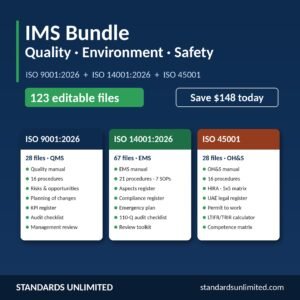
IMS Bundle – ISO 9001:2026 + ISO 14001:2026 + ISO 45001 Documentation Packages (123 Editable QHSE Templates, Word & Excel)
Original price was: $497.00.$299.00Current price is: $299.00. -
-
-
Sale!
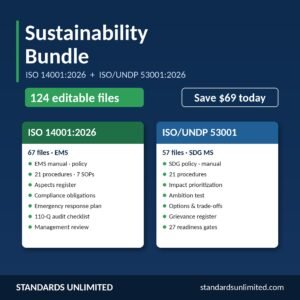
Sustainability Bundle – ISO 14001:2026 + ISO/UNDP 53001:2026 Documentation Packages (124 Editable EMS & SDG Templates, Word & Excel)
Original price was: $398.00.$229.00Current price is: $229.00.
Related products
-
Sale!
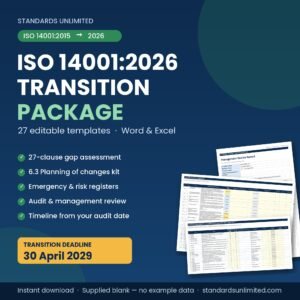
ISO 14001:2026 Transition Package – 27 Editable Templates to Move from ISO 14001:2015 (Word & Excel)
Original price was: $149.00.$99.00Current price is: $99.00. -
-
Sale!
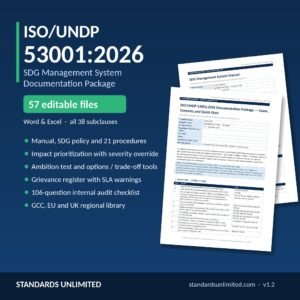
ISO/UNDP 53001:2026 Documentation Package – 57 Editable SDG Management System Templates (Word & Excel)
Original price was: $199.00.$149.00Current price is: $149.00. -
Sale!
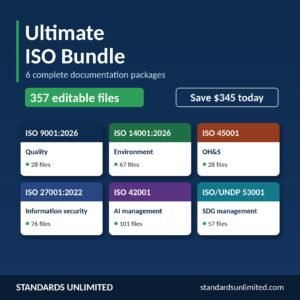
Ultimate ISO Bundle – 6 Complete Documentation Packages: ISO 9001, 14001, 45001, 27001, 42001 & 53001 (357 Editable Templates, Word & Excel)
Original price was: $1,144.00.$599.00Current price is: $599.00.
Reviews
There are no reviews yet.