Where Does the ISO 45001:2027 Revision Stand?
The ISO 45001:2027 revision has reached a critical milestone — and every organisation certified to ISO 45001:2018 needs to begin preparing now. As of June 2026, the Draft International Standard (DIS) ballot is officially open — running until September 2026 — marking the most significant milestone in the revision process since the Committee Draft was published in July 2025.
For every organisation certified to ISO 45001:2018, the message is clear: begin preparing now. The ISO 45001:2027 revision is not a cosmetic update. It signals a fundamental shift in how the international community defines occupational health and safety — expanding from physical hazard control to a holistic framework that includes mental wellbeing, psychosocial risks, remote work, climate resilience, and ESG alignment.
This guide covers everything you need to know about the ISO 45001:2027 revision — what is changing, what the DIS ballot means, and exactly what your organisation should be doing right now.
WHERE DOES THE ISO 45001:2027 REVISION STAND?
The ISO 45001:2027 revision has reached a decisive stage in 2026:
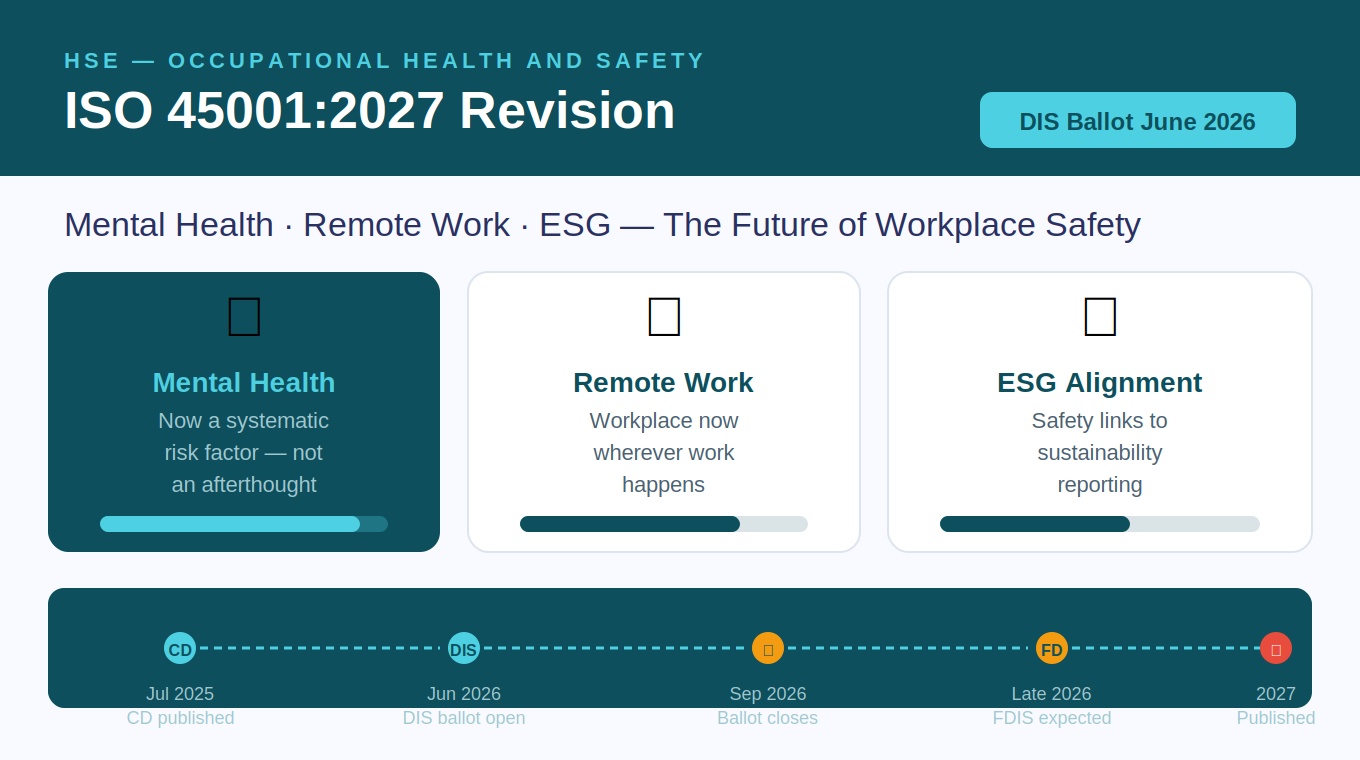
📌 July 2025 — Committee Draft (CD) published for technical review
📌 March 2026 — DIS ballot officially registered
📌 June 2026 — DIS ballot opens. Member bodies begin formal voting.
📌 September 2026 — DIS ballot closes
📌 Late 2026 — FDIS (Final Draft International Standard) expected
📌 2027 — ISO 45001:2027 officially published
📌 2027-2030 — 2 to 3 year transition period begins
The DIS ballot opening is the most significant signal yet that the content of ISO 45001:2027 is broadly finalised. While technical adjustments may follow the ballot, the direction of the revision is now firmly established.
During the transition period, ISO 45001:2018 certification remains valid. Surveillance and recertification audits will continue under the 2018 version until formal transition timelines are confirmed by accreditation bodies following publication.
WHY IS THE ISO 45001:2027 REVISION NEEDED?
The world of work has changed profoundly since ISO 45001:2018 was published. Three major shifts are driving this revision:
- Mental health is now a mainstream occupational safety issue
In 2018, psychosocial risks — stress, burnout, workplace harassment, fatigue — were rarely addressed in occupational health and safety management systems. By 2026, mental ill-health is the leading cause of long-term sickness absence in most developed economies. The safety profession has recognised that an OHSMS that ignores psychological hazards is incomplete. - The definition of workplace has fundamentally changed
When ISO 45001:2018 was written, remote and hybrid working was a minority arrangement. By 2026, it is the normal working model for millions. The ISO 45001:2027 revision explicitly recognises that the “workplace” is no longer a fixed geographic location — it is wherever work happens, including workers’ homes. This has profound implications for risk assessment, ergonomic controls, and duty of care obligations. - ESG expectations have raised the bar for workplace safety governance
Investors, regulators, and customers now scrutinise occupational health and safety performance as part of ESG assessment. The ISO 45001:2027 revision reflects this — connecting OHSMS performance to broader sustainability reporting frameworks and corporate governance expectations.
KEY CHANGES EXPECTED IN ISO 45001:2027
MENTAL HEALTH AND PSYCHOSOCIAL RISKS — NOW A CORE REQUIREMENT
The ISO 45001:2027 revision is expected to explicitly require organisations to identify, assess, and control psychosocial hazards as a systematic component of their OHSMS — not as an optional add-on.
Psychosocial hazards now formally recognised include:
→ Excessive workload and time pressure
→ Lack of job control and autonomy
→ Poor workplace relationships and interpersonal conflicts
→ Workplace harassment, bullying, and violence
→ Burnout from chronic occupational stress
→ Fatigue — particularly relevant for shift workers and long-hours cultures
New terminology is expected to appear in ISO 45001:2027 — including “psychological risk” and “psychological health and safety” — reflecting the alignment with ISO 45003:2021, the international standard for psychological health and safety at work.
What this means in practice: your hazard identification process must explicitly include psychosocial hazard identification. Your risk assessment must evaluate psychological risks. And your controls must address them — through job redesign, management training, clear reporting channels, and employee assistance programmes.
REMOTE AND HYBRID WORKING — EXPLICIT REQUIREMENTS ADDED
The ISO 45001:2027 revision brings remote and hybrid working risks into formal scope for the first time. The draft signals that “workplace” is defined as wherever work is performed — which includes domestic environments when working from home.
Practical implications for your OHSMS:
→ Risk assessments must now cover remote working arrangements — including home office ergonomics, isolation risks, and psychosocial factors of remote work
→ Domestic workstation self-assessment processes are expected to become a formal requirement
→ Communication and supervision procedures must account for workers who are not physically present
→ Emergency procedures must consider how remote workers are reached and accounted for
The revision does not require organisations to inspect workers’ homes. It requires organisations to provide the tools, knowledge, and frameworks that enable workers to manage their own safety when working remotely.
CLIMATE RESILIENCE AND ENVIRONMENTAL OH&S RISKS
ISO 45001:2027 is expected to include stronger requirements for considering climate-related occupational health and safety risks. This aligns with ISO 14001:2026 and ISO 9001:2026 — which have both formally integrated climate risk into their respective standards.
Climate-related OH&S risks to consider:
→ Extreme heat — outdoor workers and those in non-air-conditioned environments
→ Flooding — emergency evacuation and business continuity
→ Air quality — wildfire smoke and urban pollution affecting outdoor workers
→ Severe weather — risks to lone workers and those travelling for work
For organisations in the GCC region, extreme heat management is already a regulatory priority. ISO 45001:2027 is expected to provide a formal framework for managing these climate-related risks within your OHSMS.
ESG ALIGNMENT AND GOVERNANCE
The ISO 45001:2027 revision connects occupational health and safety performance more explicitly to Environmental, Social, and Governance reporting. Organisations will be expected to:
→ Measure and report OH&S performance metrics suitable for ESG disclosure
→ Demonstrate leadership accountability for OHSMS outcomes — not just policy commitment
→ Connect OHSMS objectives to corporate sustainability strategy
→ Show how OH&S performance is monitored and reported to the board
New terms including “resilience” are expected to be formally defined in the revised standard — reflecting the expectation that modern OHSMS systems must be designed to withstand disruption, not just prevent routine incidents.
SUPPLY CHAIN AND CONTRACTOR OH&S RESPONSIBILITIES
The ISO 45001:2027 revision is expected to strengthen requirements for managing occupational health and safety risks in the supply chain. This includes:
→ Extended scope to cover contractor and outsourced worker safety
→ Procurement processes must consider OH&S performance of suppliers
→ Monitoring and verification of contractor safety performance on your sites
→ Shared responsibility for complex supply chain arrangements
For organisations in manufacturing, construction, logistics, and food production where contractor and temporary worker populations are significant — this change will require meaningful updates to existing contractor management procedures.
NEW HARMONISED STRUCTURE
ISO 45001:2027 will adopt the updated Harmonised Structure — aligning with ISO 9001:2026 and ISO 14001:2026. This makes it easier to integrate occupational health and safety management with quality and environmental management in a single Integrated Management System (IMS) — reducing documentation duplication and enabling combined internal audits.
WHAT SHOULD YOUR ORGANISATION DO RIGHT NOW?
The ISO 45001:2027 revision is not yet published — but preparation can begin today. Here is your action plan:
- Review your psychosocial hazard identification — does your current hazard identification process explicitly cover stress, burnout, workplace relationships, and mental health risks?
- Conduct a remote working risk assessment — for every worker regularly working from home or remotely, document a specific risk assessment covering ergonomics, isolation, psychosocial factors, and emergency procedures.
- Add climate risks to your OH&S context analysis — identify climate-related hazards relevant to your operations and workers.
- Review your contractor management procedure — does it cover OH&S risk assessment, monitoring, and performance verification for all contractors and outsourced workers?
- Align with ISO 45003:2021 — the international guidance standard for psychological health and safety. Implementing it now prepares your OHSMS for ISO 45001:2027 requirements.
- Monitor the DIS ballot — the ballot closes September 2026. FDIS content expected late 2026. Subscribe to ISO and certification body updates.
THE BOTTOM LINE
The ISO 45001:2027 revision is not a bureaucratic update. It is the international safety community’s response to a fundamentally changed world of work — one where mental health is a safety issue, remote work is the norm, climate risks are real, and ESG accountability extends to worker wellbeing.
The organisations that prepare early will build stronger, more holistic OHSMS systems. The organisations that wait for the final standard and scramble to transition will find themselves rushing through requirements that deserve genuine implementation.
Start with psychosocial hazards and remote work risk assessments. These are the two most significant additions — and the preparation work begins today.
👉 Download your free ISO 45001 gap analysis checklist at standardsunlimited.com/free
ISO45001 #ISO450012027 #OccupationalHealth #MentalHealth #RemoteWork #WorkplaceSafety #HSE #PsychosocialHazards #ISO45001Revision #ESG #SafetyManagement #ISOTransition #HealthAndSafety