
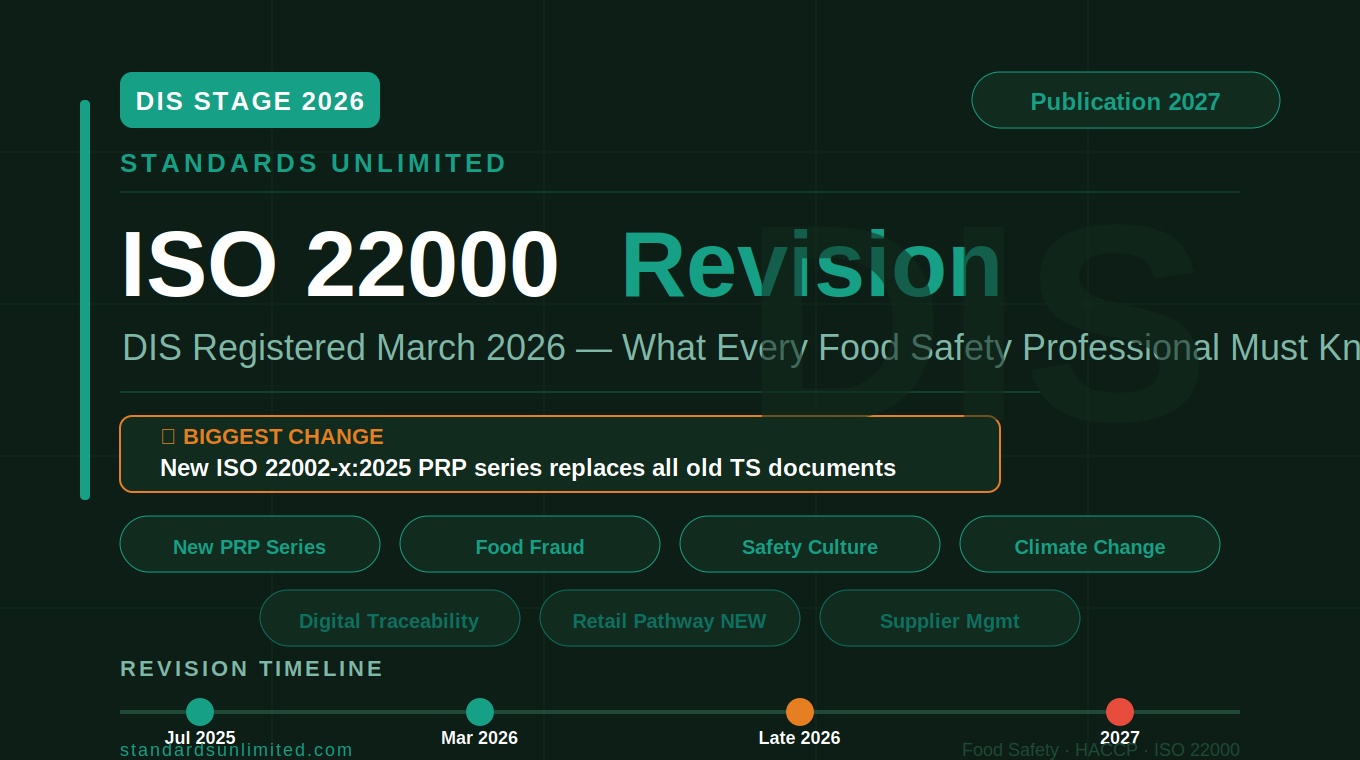
ISO 22000 Is Being Revised — DIS Stage 2026: What Every Food Safety Professional Must Know
ISO 22000 is the backbone of food safety management for organisations across the global food chain. From primary producers to food manufacturers, caterers, packaging companies, retailers, and logistics providers — ISO 22000 provides the internationally recognised framework for identifying, controlling, and managing food safety hazards from farm to fork.
The current version — ISO 22000:2018 — has served the food industry well. But the food safety landscape has changed significantly since 2018. New PRP standards have been published, GFSI benchmarking requirements have been updated, sustainability and climate risks have entered food safety thinking, and the relationship between ISO 22000 and GFSI-recognised schemes like FSSC 22000 has evolved substantially.
In March 2026, the Draft International Standard (DIS) for the revised ISO 22000 was formally registered and entered the 12-week ballot phase with ISO member bodies. Publication of the new version is anticipated in 2027, followed by a three-year transition period.
⚠️ Important: ISO 22000:2018 remains the current valid standard. The most time-consuming preparation work — reviewing PRP documentation against the new ISO 22002-x:2025 series — can and should begin immediately, as these standards are already published.
WHY IS ISO 22000 BEING REVISED?
Five key drivers are behind this revision:
📌 New ISO 22002-x:2025 PRP series — the old ISO/TS 22002 technical specification series was replaced by full International Standards in July 2025
📌 New ISO 22002-100:2025 core standard — a brand new core PRP standard covering all sectors is now the foundation of prerequisite programmes across the food chain
📌 GFSI Benchmarking 2024 — ISO 22000 must align with updated GFSI requirements including food safety culture, food fraud, food defence, and traceability
📌 Climate change amendment — ISO 22000:2018/Amd 1:2024 added climate action requirements which will be formally integrated into the main standard body
📌 New retail and wholesale pathway — ISO 22002-7:2025 created PRP requirements for retail and wholesale for the first time in ISO history
THE NEW ISO 22002-x:2025 PRP SERIES — THE MOST IMPORTANT CHANGE
If you take one thing from this article, it should be this: the replacement of the ISO/TS 22002 Technical Specification series with the new ISO 22002-x:2025 International Standards is the single most significant operational change in the revised ISO 22000.
Prerequisite Programmes — PRPs — are the operational foundation of every food safety management system. Under ISO 22000:2018, PRPs were based on ISO/TS 22002 technical specifications. From 2025, these have been replaced:
OLD → NEW:
ISO/TS 22002-1:2009 → ISO 22002-1:2025 (Food manufacturing)
ISO/TS 22002-2:2013 → ISO 22002-2:2025 (Catering)
ISO/TS 22002-4:2013 → ISO 22002-4:2025 (Food packaging manufacturing)
ISO/TS 22002-6:2016 → ISO 22002-6:2025 (Feed and animal food production)
NEW → ISO 22002-100:2025 (ALL sectors — core PRP requirements)
NEW → ISO 22002-7:2025 (Retail and wholesale — first time in ISO history)
The most significant addition is ISO 22002-100:2025 — a brand new core standard that consolidates common PRP requirements applicable across every food chain sector. Every organisation implementing ISO 22000 will need to apply ISO 22002-100:2025 alongside their sector-specific standard.
What this means for your site: review every existing PRP procedure — cleaning schedules, pest control, personal hygiene, allergen management, maintenance programmes — against both ISO 22002-100:2025 and your sector-specific ISO 22002-x:2025 standard. This is not just a documentation update. The new standards include updated technical requirements that may require changes to actual practices, not just documents.
EXPECTED KEY CHANGES IN THE REVISED ISO 22000
- Integration of the New ISO 22002-x:2025 PRP Framework
The revised standard will formally reference the new ISO 22002-x:2025 series as the basis for PRP requirements. Organisations must demonstrate compliance with both ISO 22002-100:2025 and the relevant sector-specific standard. - New Retail and Wholesale Sector Pathway
ISO 22002-7:2025 creates a formal PRP framework for retail and wholesale operations for the very first time in ISO history. The revised ISO 22000 will formally accommodate these organisations as a distinct certification pathway. - Food Fraud and Food Defence — More Explicitly Required
VACCP (Vulnerability Assessment and Critical Control Points for food fraud prevention) and TACCP (Threat Assessment and Critical Control Points for food defence) are expected to be formally embedded in the revised standard — aligned with GFSI Benchmarking 2024. These were referenced but not fully defined in ISO 22000:2018. - Strengthened Food Safety Culture Requirements
Aligned with GFSI and FSSC 22000 Version 7 direction, the revised ISO 22000 is expected to include stronger, more defined requirements for food safety culture — moving beyond having a policy to demonstrating that culture is embedded across the organisation. - Climate Change — Formally Integrated
ISO 22000:2018/Amd 1:2024 added climate action requirements as a separate amendment. The DIS formally integrates these into the body of the standard. Climate-related food safety risks — such as temperature changes affecting pathogen growth, water scarcity affecting cleaning processes, or extreme weather affecting supply chains — must be considered in FSMS context analysis. - Digital Traceability Considerations
The revised standard is expected to include clearer requirements on traceability — with guidance on digital traceability systems. Traceability evidence increasingly exists in digital form and must be managed accordingly. - Strengthened Supplier Management
More explicit requirements for managing supplier food safety performance — including approval processes, ongoing monitoring, and defined responses when suppliers fall below required standards. - New Harmonised Structure
The revised ISO 22000 will adopt the current Harmonised Structure — aligning more closely with ISO 9001:2026, ISO 14001:2026, and ISO 45001 for organisations implementing Integrated Management Systems.
THE RELATIONSHIP BETWEEN ISO 22000 REVISION AND FSSC 22000 VERSION 7
Many food safety professionals are asking how the ISO 22000 revision relates to FSSC 22000 Version 7, published 1 May 2026. The key distinction:
FSSC 22000 Version 7 is built on ISO 22000:2018 plus FSSC additional requirements, now incorporating the new ISO 22002-x:2025 PRP series. The revised ISO 22000 (publication 2027) will eventually replace ISO 22000:2018 as the foundation of FSSC 22000 in a future version.
💡 Pro tip: If your organisation is transitioning to FSSC 22000 Version 7, your ISO 22002-x:2025 PRP review work counts toward both the FSSC V7 transition AND your preparation for the revised ISO 22000. Do it once — it benefits both systems.
EXPECTED TRANSITION TIMELINE
🔵 July 2025 — ISO 22002-x:2025 series published — preparation can begin now
🔵 August 2025 — ISO 22000 committee draft comment period closed
🔵 March 2026 — DIS formally registered — 12-week ballot begins
🟡 Late 2026 — FDIS expected following ballot
🟢 2027 — New ISO 22000 version published — transition window opens
⬜ 2027-2030 — 3-year transition period for all certified organisations
WHAT SHOULD YOU DO RIGHT NOW?
- Review ISO 22002-100:2025 — obtain and study the new core PRP standard. This applies to every organisation regardless of sector.
- Identify your sector-specific standard — obtain the relevant ISO 22002-x:2025 standard and review it against your current PRP procedures.
- Conduct a PRP gap analysis — compare your existing prerequisite programme documentation. Document your gaps systematically.
- Review your food fraud and food defence plans — ensure VACCP and TACCP plans are current, risk-based, and up to date.
- Add climate change to your FSMS context analysis — document climate-related food safety risks relevant to your operations and supply chain.
- Review your traceability system — ensure you can demonstrate one-step-forward one-step-back traceability with documented evidence.
- Monitor the DIS ballot outcome — follow ISO TC 34/SC 17 progress for FDIS publication.
THE BOTTOM LINE
The ISO 22000 revision is progressing steadily. But the most important preparation — reviewing and updating PRP documentation against the new ISO 22002-x:2025 series — can begin right now. The organisations that start early will have smoother transitions, stronger food safety systems, and better audit outcomes.
Food safety management has never been more important or more scrutinised. The revised ISO 22000 reflects a food safety landscape that demands more from every organisation in the food chain — not just compliance, but demonstrated, systematic, improving food safety performance.
The PRP review is the most time-consuming part of the transition. Start it now. Use the ISO 22002-x:2025 series as your guide. Everything else flows from having solid prerequisites in place.