
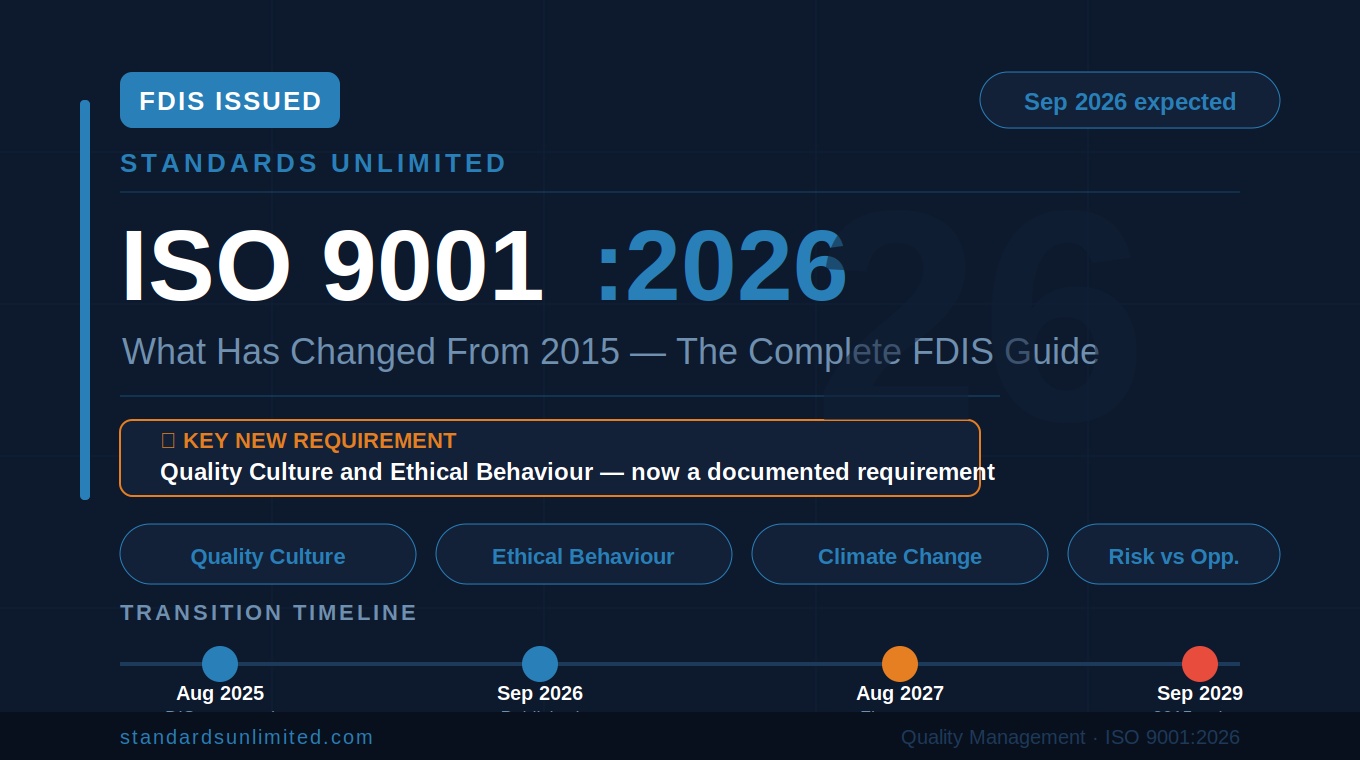
ISO 9001:2026 is the world’s most widely used management system standard. With over one million certified organisations across 189 countries, its next revision matters to more quality professionals than any other standards update in the world.
The Final Draft International Standard — ISO FDIS 9001:2026 — has been issued. Publication is targeted for September 2026, followed by a three-year transition period giving organisations until approximately September 2029 to update their Quality Management Systems.
The good news for certified organisations is clear: this is an evolution, not a revolution. The core requirements of ISO 9001 remain intact. But several targeted changes introduce genuinely new expectations — particularly around quality culture, ethical behaviour, sustainability, and how organisations manage risk versus opportunity.
⚠️ Important: ISO 9001:2015 remains the only valid, certifiable version until the final standard is officially published in September 2026. All current certifications, surveillance audits, and recertification’s continue under ISO 9001:2015 until that date.
WHY IS ISO 9001 BEING REVISED?
ISO 9001:2015 was published over a decade ago — a period that has seen dramatic changes in how organisations operate, what their stakeholders expect, and what risks they face. Six key shifts have reshaped quality management since 2015:
✅ Digital transformation — quality systems must support digital processes and data-driven decision making
✅ Sustainability expectations — customers, regulators, and investors expect environmental and social responsibility to be embedded in operations
✅ Ethical governance — corporate scandals globally have driven demand for ethics and culture to be explicit, documented requirements
✅ Resilience — supply chain disruptions, pandemics, and geopolitical instability have made organisational resilience a quality imperative
✅ Stakeholder complexity — the range of interested parties organisations must consider has expanded significantly
✅ Human factors — the role of human error in quality failures is now better understood and must be explicitly addressed
ISO 9001:2026 CHANGES — CLAUSE BY CLAUSE
Clause 4.1 — Context
Climate change is formally integrated into the main body of the standard. The 2024 amendment that made climate change consideration mandatory is no longer a separate document — it is embedded in Clause 4.1. Every organisation must now review their context analysis to ensure climate change is explicitly addressed.
Clause 4.2 — Interested parties
Expanded guidance on identifying and managing the needs of interested parties — including supply chain partners and community stakeholders. Review your interested party register for completeness.
Clause 5.1 — Leadership
NEW: Top management must now actively promote and demonstrate quality culture and ethical behaviour. This was implied in ISO 9001:2015 — from 2026, it is a documented requirement with audit evidence expected.
Clause 5.2 — Quality Policy
The quality policy must now more explicitly reflect the organisation’s strategy and external context — including sustainability and ethical commitments.
Clause 6.1 — Risks and opportunities
Risks and opportunities are now more clearly distinguished, with separate consideration and actions required for each. Opportunity-based thinking is significantly strengthened.
Clause 6.3 — Change management
Requirements for managing planned changes are reinforced — changes to the QMS must be formally assessed and documented before implementation.
Clause 7.3 — Awareness
Employees must now understand quality culture and ethical behaviour as part of their QMS awareness — not just quality policy and objectives. Update induction and refresher training accordingly.
Clause 8 — Operation
Human error prevention receives greater attention. Processes must consider the potential for human error and include appropriate controls at critical steps.
Clause 10 — Improvement
Continual improvement is more explicitly linked to leadership responsibility and quality culture — not just corrective action processes.
THE TWO MOST IMPORTANT CHANGES IN DETAIL
- Quality Culture and Ethical Behaviour — Now a Documented Requirement
This is the change receiving the most attention from quality professionals globally — and rightly so.
In ISO 9001:2015, quality culture was implied. Senior leaders were expected to demonstrate commitment and support the QMS — but organisational culture was never explicitly stated as a requirement.
In ISO 9001:2026, this changes. Clause 5.1 requires top management to actively promote and demonstrate both quality culture and ethical behaviour. Clause 7.3 extends this into employee awareness — every relevant person in the organisation must understand what these mean in practice.
A new note in the standard clarifies that culture and ethics can be demonstrated through shared values, beliefs, history, attitudes, and observed behaviours. You do not need a new culture programme or an ethics consultant. You need a light but clear evidence trail:
✅ An ethics section in your quality manual or a standalone ethical behaviour policy
✅ Quality culture referenced in leadership communications — emails, briefings, management review minutes
✅ Training records showing staff awareness of quality culture and ethical behaviour
✅ Management review discussions covering culture and values — not just metrics
✅ Visible leadership commitment — evidence management champions quality culture
- Risks and Opportunities — Separated and Strengthened
In ISO 9001:2015, risks and opportunities were addressed together under Clause 6.1 — a pairing that many organisations found confusing. Opportunities were frequently treated as secondary considerations rather than distinct requirements.
ISO 9001:2026 separates these clearly. Risks require systematic identification, assessment, likelihood, impact analysis, and mitigation. Opportunities require separate identification, evaluation, feasibility assessment, and exploitation planning. The FDIS strengthens opportunity-based thinking significantly — organisations must demonstrate they actively seek and pursue opportunities for improvement.
CLIMATE CHANGE — FORMALLY IN CLAUSE 4
In February 2024, ISO published an amendment to ISO 9001:2015 making it mandatory to consider whether climate change is relevant to the organisation’s context. ISO 9001:2026 formally integrates this amendment into Clause 4.1.
In practice this means:
→ Add climate change to your Clause 4.1 context analysis — document whether it is relevant and how
→ If relevant, consider how it affects operations, supply chain, customer expectations, or regulatory environment
→ Link any climate-related risks or opportunities to your Clause 6.1 assessment
WHAT IS NOT CHANGING
The core structure and requirements remain the same. The High Level Structure is updated to the new Harmonised Structure (HS) — same intent, cleaner alignment with other ISO standards. Customer focus, process approach, risk-based thinking, evidence-based decision making, PDCA cycle, and certification structure are all unchanged. For well-run organisations with a solid ISO 9001:2015 system, this transition should be straightforward.
TRANSITION TIMELINE
🔵 27 August 2025 — DIS approved by ISO member bodies
🔵 Early 2026 — FDIS issued — content now stable
🟢 September 2026 — ISO 9001:2026 officially published
🟡 August 2027 — First ISO 9001:2026 certificates expected
🔴 September 2029 — ISO 9001:2015 retires — all organisations must hold 2026 certificate
YOUR 10-STEP TRANSITION ACTION PLAN
- Read the FDIS — obtain and review the Final Draft International Standard
- Conduct a gap analysis — compare your current QMS clause by clause against 2026 requirements
- Update your quality policy — reflect strategy alignment, climate considerations, and ethical behaviour
- Build your quality culture and ethics evidence trail — policy, training records, communications
- Separate risks from opportunities in Clause 6.1 — create distinct treatment plans for each
- Add climate change to your Clause 4.1 context analysis
- Update awareness training — include quality culture and ethical behaviour explicitly
- Review your change management procedure — ensure QMS changes are formally assessed
- Update your internal audit checklist — add questions on culture, ethics, and restructured risk management
- Contact your certification body — ask about transition audit plans and timing
THE BOTTOM LINE
ISO 9001:2026 will not require you to rebuild your QMS from scratch. For well-run organisations, the transition should be focused work in a small number of areas. The FDIS message is clear: quality management is about building resilient, ethical, digitally-enabled systems capable of adapting to change while consistently delivering value to customers.
Start with a gap analysis today. The organisations that begin early will transition smoothly — those that wait will face time pressure.
Thank you for sharing this update.
I am particularly interested in the statement: “August 2027 — First ISO 9001:2026 certificates expected.”
Could you kindly provide a reference for this date? I have not yet seen any official publication from ISO, ISO/TC 176/SC 2, IAF, or accreditation bodies that establishes August 2027 as the expected date for the first ISO 9001:2026 certifications.
Given that the final publication of ISO 9001:2026 and the corresponding IAF transition arrangements are still pending, this date appears to be a projection rather than a formally established milestone.
Any official source or supporting reference would be greatly appreciated.
Thanks for comments. You are correct that htis date is a projection. Thanks.