
ISO 14064 Verification: 6 Proven Steps for GCC Companies
Plan ISO 14064 verification in 6 proven steps: what verifiers check, how the UAE climate law fits, and a Dubai logistics example for GCC companies.

Plan ISO 14064 verification in 6 proven steps: what verifiers check, how the UAE climate law fits, and a Dubai logistics example for GCC companies.

The ISO 53001 SDG management system standard, published jointly by ISO and UNDP on 28 September 2026, is the first International Standard that treats the UN Sustainable Development Goals as something an organisation systematically manages, not just reports on. Until now, most organisations handled the SDGs through a sustainability report and a few headline commitments….
ISO 26000 social responsibility guidance is one of the most misunderstood documents in the entire ISO catalogue — mostly because people assume it works like every other ISO standard they’ve encountered, and it doesn’t. There is no certificate. No certification body will audit you against it. And that’s deliberate, not a gap — it changes…

Scope 3 emissions supply chain data is the part of the carbon footprint almost every business under-measures — and it’s typically the largest part of the footprint by far. For most organisations, Scope 3 accounts for the majority of total emissions, often well over half, because it captures everything happening in the value chain before…

An ISO 14064 carbon footprint inventory is the technical foundation underneath almost every GCC ESG mandate now landing on businesses’ desks — the reporting frameworks tell you what to disclose, ISO 14064 tells you how to actually measure it credibly. If you’ve never built a GHG inventory before, the terminology alone can be a barrier….

Picking the right ESG reporting framework GCC regulators now expect has gone from a nice-to-have to a compliance deadline with real penalties attached, almost overnight. Every stock exchange in the region has introduced ESG disclosure requirements, and the frameworks they point to are converging on one baseline — even as country-specific rules layer extra obligations…

Net zero UAE 2050 is not a corporate aspiration. It is a national strategic commitment backed by federal law, regulatory frameworks, and an accelerating commercial ecosystem that is beginning to exclude organisations that cannot demonstrate climate credentials. The UAE Net Zero by 2050 Strategic Initiative was announced in October 2021 ahead of COP26 — making…
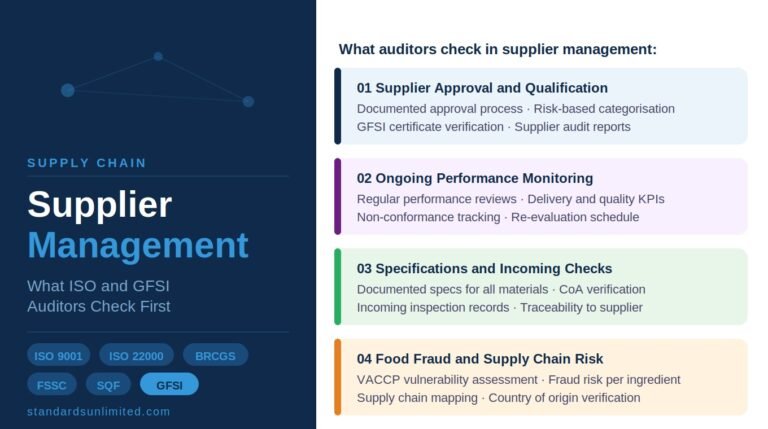
Supplier management is consistently one of the highest-scoring areas for non-conformances in ISO and GFSI audits globally. It is also one of the most commonly misunderstood — because organisations often treat supplier management as a one-time approval exercise rather than an ongoing, systematic control. Whether you are certified to ISO 9001, ISO 22000, BRCGS Food…

A legal compliance register is not optional if your organisation holds or is pursuing certification to ISO 9001, ISO 14001, or ISO 45001. It is a formal requirement — and one of the most common sources of non-conformances in certification audits globally. Yet despite being mandatory, legal compliance registers are frequently maintained poorly — out…
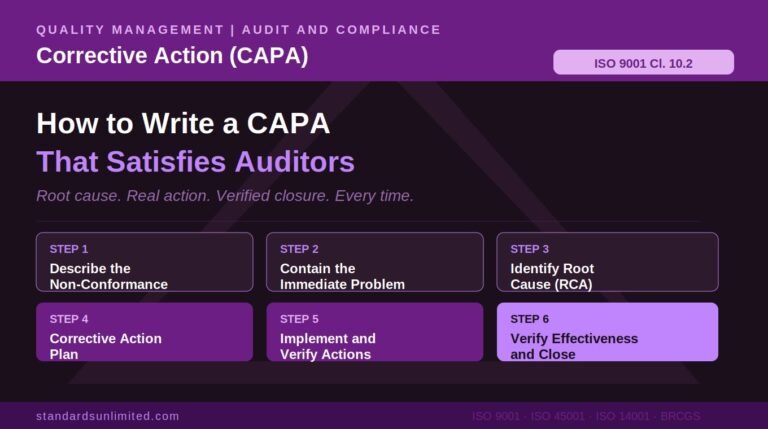
A corrective action CAPA process is one of the most scrutinised elements in any ISO or GFSI audit. Auditors do not just check whether you have a CAPA form — they check whether your corrective actions are genuine, whether your root cause analysis goes deep enough, and whether you have verified that the problem has…